Hi, I'm Louisa Ells. I'm Professor of Obesity and co-director of the Obesity Institute here at Leeds Beckett University and it is a great pleasure to speak to you today about an area I am hugely passionate about and that is addressing weight stigma and related bullying.
So, I'd like to start by just asking you to take a look at these two young people. And I'll ask you what might they have in common and what differences do you notice? I can tell you that they both share one thing in common and that is they both live with a chronic disease.
So, Gemma here lives with asthma and Nazia lives with obesity. The only difference is that Nazia can't hide her label. She has to wear her label every single day. Now, even though both of these diseases can be modified by lifestyle changes, it's only Nazia who is judged by the way she lives her life. Just because we know Nazia lives with obesity, does that really give us the right to cast judgment and blame? Absolutely not.
So, do you think headlines such as these are acceptable? Why I refuse to let my daughter be taught by a fat teacher. Heffalump traps will clear the NHS of fatties. Headlines which can be hugely hugely damaging. However sadly, this weight related stigma isn't just limited to what we see and what we hear in the media. It occurs across society from members of the public, across our schools, even our friends and family. Even the health care professionals who are here to help can hold stigmatising and misinformed attitudes towards people living with obesity.
And this is illustrated in a quote from a study undertaken in Bristol a few years ago now where a mum recalls a recent GP appointment with her daughter where he, the GP, said in front of her daughter, "God, she's obese, how on earth can you let her get that size?" You know, "You've simply got to cut down, you're giving her the wrong foods. Do you realise how much of a health issue that is? She shouldn't be that size." I'd just like to ask you, do you think this mum and her daughter would have received the same stigmatising and judgemental response from this same GP if she'd gone because her daughter was suffering from asthma triggered by the severe damp in their house?
However, as I say this is a relatively old study. It was published back in 2012, so well over a decade ago, plenty of time for attitudes to have changed right? Sadly not. This article was published just in the last couple of years in NHSmanagers.net where the authors posed this question. Is overweight and obesity always just because of eating too much or taking insufficient exercise? Which they responded with, 'the answer is almost always yes,' whereas we know the correct answer is almost always no. We know that obesity is a highly complex chronic disease with over a hundred different determinants, many of which are completely out of our individual control.
And we know the impact of such stigmatisation can be hugely damaging. We know that weight stigma is associated with new numerous physical and psychological harms which can impact health and wellbeing and lead to health care avoidance and widening inequalities. And we know that this vicious circle of weight-related bullying and increased stigma associated with paediatric obesity can lead to poor self-esteem, depressive disorders, impaired school performance, decreased social involvement, which can in turn can lead to an increase in the risk of developing eating disorders, unhealthy weight control behaviours, and further weight gain. This horrible vicious cycle has got to stop.
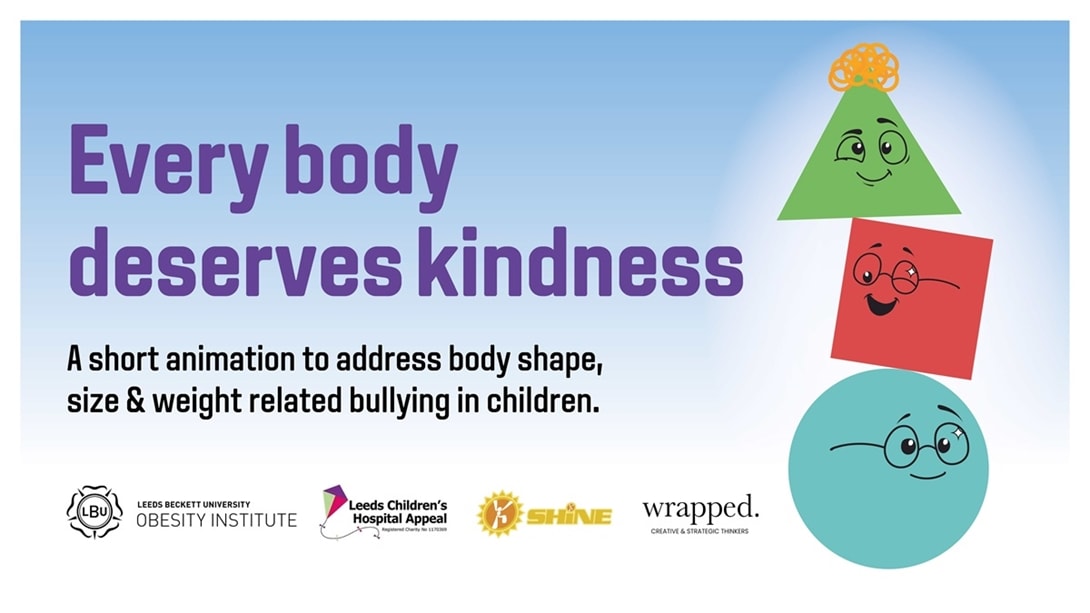
So, this is why we had the great pleasure of working with the most awesome young people and families alongside colleagues from Leeds Teaching Hospital and The Shine Service to codevelop a short film and some resources to help address weight-related bullying in primary school with the key message being that no matter what your shape or size, everybody deserves kindness. So, it's a great pleasure to be able to share this video with you today.
We are all different in many ways. Some of us wear glasses, some have curly hair, and some have different skin colours. Our bodies come in many shapes and sizes too and that's perfectly okay.
Sometimes people bully others by saying mean things about how they look. They might think it's a joke but bully can hurt a lot.
Having a bigger body is not something you can blame someone for. Just like you can't blame someone for needing glasses or having a different hair colour. Body size, just like these other traits, is part of what makes people unique and special, and we should respect those differences.
Everyone deserves kindness no matter what they look like. Being kind can stop bullying and make everyone feel better, even those who are being bullies.
If someone is bullying you about your body or anything else, talk to a grown up you trust. They can help you just like with any other problem.
Sometimes people bully others because they are dealing with their own difficult feelings. Understanding why someone bullies is important and helping them change.
We are all different and that's something to celebrate. Let's be kind to each other and make sure everyone feels included and happy.
Remember, everyone is special just the way they are. Let's make our school a place where everybody feels safe and happy.
So, I really hope you find that a useful resource. It will be freely available to download from the Obesity Institute website, and we are currently working with some fantastic schools across Yorkshire to develop a teaching resource pack which will be available hopefully very soon. So, please do keep your eye out on our social media and our website if you're interested in the teaching pack, or if you would like a copy sent to you as soon as it's available, you can email our Obesity Institute inbox and pre-register for a copy and so it will be with you as soon as it's done. So, that just leaves me to say a huge thank you for joining me today and please do contact me if you have any further questions.