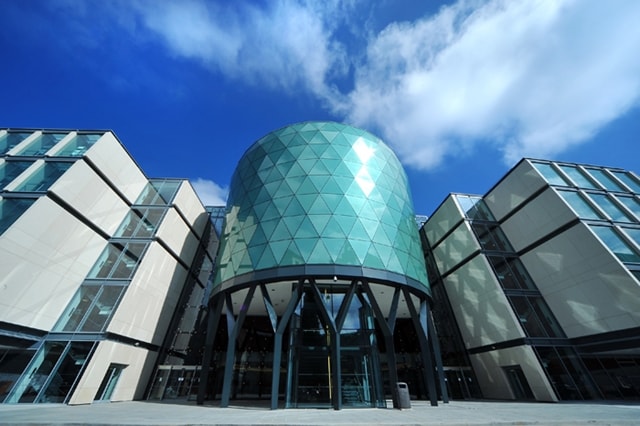
Leeds Beckett University - City Campus,
Woodhouse Lane,
LS1 3HE

The 200-year history of Leeds Beckett University
The Leeds Beckett University that we know today has had a rich history of changes, all of which have contributed to making it the institution it is today. Over the past 200 years, the university has perhaps seen as much change as the city of Leeds itself. Even today, as it did 200 years back, it continues to be a vital part of the fabric of Leeds and continues to retain its strong links to the Leeds community.


Here is a brief history of what this 200-year journey has looked like.
Leeds Mechanics Institute
The Leeds Mechanics’ Institute was founded in 1824, laying the foundations for Leeds Beckett University as we know it today.
A meeting was held in the Court House of Leeds (which stood at the bottom of Park Row). After a year of meeting and proposals the Leeds Mechanics’ Institute came into being on Wednesday 1 December 1824. The institute was located in two rooms in premises on Park Row, a library and a classroom and was primarily concerned with chemistry and other sciences. In 1841 the Institute moved to new premises in South Parade.

The Leeds Mechanics’ Institute and Literary Society
The Leeds Mechanics’ Institute amalgamated with the Leeds Literary Society in 1842 to form the Leeds Mechanics’ Institute and Literary Society. New premises were opened on Cookridge Street in 1868 in a building designed by architect Cuthbert Brodrick. The Institute now housed a Library, a Reading Room, and the Leeds School of Art and Leeds Technical School within its premises.
The Leeds Institute of Science, Art and Literature
In 1897 members of the Institute adopted a new name, the Leeds Institute of Science, Art and Literature, to better reflect the educational activities, which also included the Leeds Boys’ Modern School and Leeds Girls’ Modern School under the umbrella of the Institute. The next year the Leeds School of Music and Commercial Evening School departments were also established.

Transfer of schools to Leeds Corporation
The transfer of the privately funded Leeds Institute of Science, Art and Literature to Leeds Corporation began in 1906. This was in the wake of the 1902 Education Act that created the Leeds Education Authority which took over and expanded the role of the former School Board.
City of Leeds Training College
The City of Leeds Training College was formed in 1907 in temporary accommodation across the city. A permanent college was established on the grounds of Kirkstall Grange, sold to Leeds Education Authority by Lord Grimthorpe. The new college buildings were opened on 13 June 1913 by the President of the Board of Education, J A Pearce. In 1914 almost all the college buildings were transferred to the military for use as a hospital until 1927. The college continued in temporary spaces around Leeds. In 1939 the college campus was again used for military purposes, mainly as a depot and training facility.

Yorkshire Training College of Housecraft
The Yorkshire School of Cookery in Leeds was formed in 1874 by the Ladies’ Honorary Council of the Yorkshire Board of Education. It evolved into the Yorkshire Training School of Cookery between 1877 and 1884 and the Yorkshire Training School of Cookery and Domestic Economy 1884 to 1920. The school came to be known as ‘Pud School’, possibly in reference to the legendary Yorkshire Pudding. In 1920 the school gained college status and became the Yorkshire Training College of Housecraft, eventually becoming the Yorkshire College of Education and Home Economics from 1965 to 1970. For many years the college was located on Vernon Road.

Leeds Law School
On 16 September 1924 the Leeds Central School of Commerce opened its doors to a Day Department. Among the subjects to be taught was Commercial Law by M F B (Myles Falcon Downes) Archibald, a Leeds Barrister. Some aspects of commercial law had been taught before 1924 but the formation of the Day Department put it on a firmer footing and thus laid the foundation for the Leeds Law School.
Leeds College of Commerce
In 1926, the Leeds Central School of Commerce was granted college status and became the Leeds College of Commerce. This year marked the incorporation of Commercial Evening Classes into the Leeds Institute of Science, Art and Literature. For a quarter of a century before this, commercial education courses were gradually grouped into the Leeds Central School of Commerce and day courses were established in 1924.

Leeds College of Art
The Leeds School of Art was granted college status in 1927 and became the Leeds College of Art. It first began as the Leeds Government School of Design, opened in 1846, as part of the Leeds Mechanics’ Institute and Literary Society. The school received initial practical and financial help from the School of Design based in London, and subsequently became the Leeds School of Arts in 1856. Leeds College of Art moved from its Vernon Street site to Woodhouse Lane to form part of Leeds Central Colleges in 1969.
Carnegie College of Physical Training
The Carnegie College of Physical Training was opened in 1933 next to the City of Leeds Training College. Its first warden was Ernest Major who created the foundation for its reputation for excellence in sports teaching. In 1947 it was renamed Carnegie College of Physical Education, dropping ‘Training’ for the more academically focussed ‘Education’. During World War Two the college was closed, reopening in 1947.

Leeds College of Technology
The Leeds School of Science was formed as part of the Leeds Mechanics’ Institute and Literary Society in 1868. The school was renamed Leeds Technical School in 1896 and Leeds Technical College in 1927. It became the Leeds College of Technology in 1937. The mechanical engineering department of this this college was the first to move to the new Central Colleges site in 1956.
The Leeds Central Colleges
The Leeds Colleges of Art, Commerce and Technology and the Yorkshire College of Education and Home Economics were gradually brought together on a site just north of Leeds Civic Hall. The first college on site was the Leeds College of Technology with Mechanical Engineering and Building opened by Clement Atlee in 1956. Over the next decade the rest of technology, most of commerce, housecraft and art were accommodated on site.

College merger at Beckett Park
In 1964 the City of Leeds Training College changed its name to the City of Leeds College of Education in response to the Robbins Report (1963). Its neighbour at Beckett Park was the Carnegie College of Physical Education. There was much overlap in the administration and physical spaces shared by the Colleges and in 1968 they formally merged to create the City of Leeds and Carnegie College.
Leeds Polytechnic
In 1966, the White Paper “A Plan for Polytechnics and Other Colleges” began the process of polytechnic creation. Leeds was at a great advantage in this having worked on the concept of a central college for around 40 years. Much of the administrative and campus infrastructure had already been established by the Leeds Central Colleges. In 1970 Leeds Polytechnic came into being. Leeds Polytechnic left the Local Education Authority to become a Higher Education Corporation in 1989.

Leeds Polytechnic grows
The City of Leeds and Carnegie College and the James Graham College (the former Leeds Day Training College created in 1959) joined Leeds Polytechnic in 1976.
Leeds Metropolitan University
Leeds Polytechnic became Leeds Metropolitan University in 1992 with the power to confer its own degrees and other awards. Leslie Wagner was its first Vice Chancellor.
Leeds Beckett University
Leeds Metropolitan University became Leeds Beckett University in 2014 as we know it now, with Professor Susan Price CBE as the first Vice Chancellor, succeeded soon by Professor Peter Slee who continues to lead the university today. The university now has nine major schools, 220,000 alumni across 170 countries, more than 32,000 current students, and over 150 partners and franchise institutions all over the world.
Learn more about our history and heritage here.
Images and historical information have been contributed by Dr Keith Rowntree from our Archive and Special Collections department.