
Leeds Beckett University - City Campus,
Woodhouse Lane,
LS1 3HE
Stories
LBU Research Voices – A charity-funded PhD journey to stop the spread of skin cancer
Welcome to LBU Research Voices, a blog series that celebrates the experiences, journeys, and expertise of our LBU research community. Through this series, we’ll explore the knowledge our researchers have gained - not just from their work, but from their lived experiences, career paths, and the communities they engage with. By sharing their stories, we hope to inspire learning, reflection, and connection across our LBU research culture.
In our new post, we met up with Jacob Gillett-Woodley, a PhD researcher fully funded by a studentship from the British Skin Foundation. Jacob tells us how he hopes his research could help stop the spread of skin cancer to the brain – and shares his advice around applying for studentships and funded PhDs.

Stories

Hi Jacob, Can you summarise your PhD project and its goals for someone unfamiliar with the field?
My project is focused on skin cancer and how melanoma – which is the most aggressive type of skin cancer - has a tendency to spread to the brain. Someone will get an initial tumour which will then spread out, or metastasise; and we are interested in what orchestrates these changes – and if they can be detected early. So what are the mechanisms that allow melanoma to seat itself and grow in these other areas?
My PhD is fully funded by the British Skin Foundation – and I am looking specifically at extracellular vesicles (EVs). EVs are tiny, bubble-like structures that are released by nearly all cells into the surrounding fluid (like blood, saliva, or tissue fluid). Think of them as little "packages" that cells use to send messages or materials to other cells. It has been found that cancer cells can use these EVs to send signals to other tissues to prepare them for invasion. But the how, what and why do these EVs prepare the brain for invasion in melanoma has not been researched. My research will be investigating these EVs - what are they doing to the brain? and how are they doing it?

How will the charity use your research – and how do you hope your research will make a difference to people’s lives?
If we find that EVs do contain signals that can indicate that someone is going to develop that further stage of melanoma cancer – if we can find a specific signalling profile – then we could introduce this to a hospital setting. This would allow doctors to see if someone is at a high risk of developing metastatic brain cancer, and keep them under very close watch.
I am also looking at EVs as a targeting point – a lot of treatments just look at cancer cells themselves and kill them. If we can target the signals that the cancer is producing, we can block and stop that progression of the disease.
Another area that I am investigating is a type of cell called a fibroblast. When you hear about cancer in the news, you tend to imagine it as being one contained area, with just cancer cells present. What you actually have is a cancer cell, and then other cells that were normally healthy, that have been turned to the cancer side in order to support its growth. Fibroblast cells are normally like housekeepers – they tidy up tissues and keep things running well. It has been found that these support cancer cells and their growth - and we believe that the signals the EVs deliver, are helping the cancer to grow. So another avenue is the idea that if we block these fibroblasts from producing signals (or just directly target the fibroblasts), you can then stunt the cancer growth – stopping it spreading and giving it a higher chance for treatment to be effective.
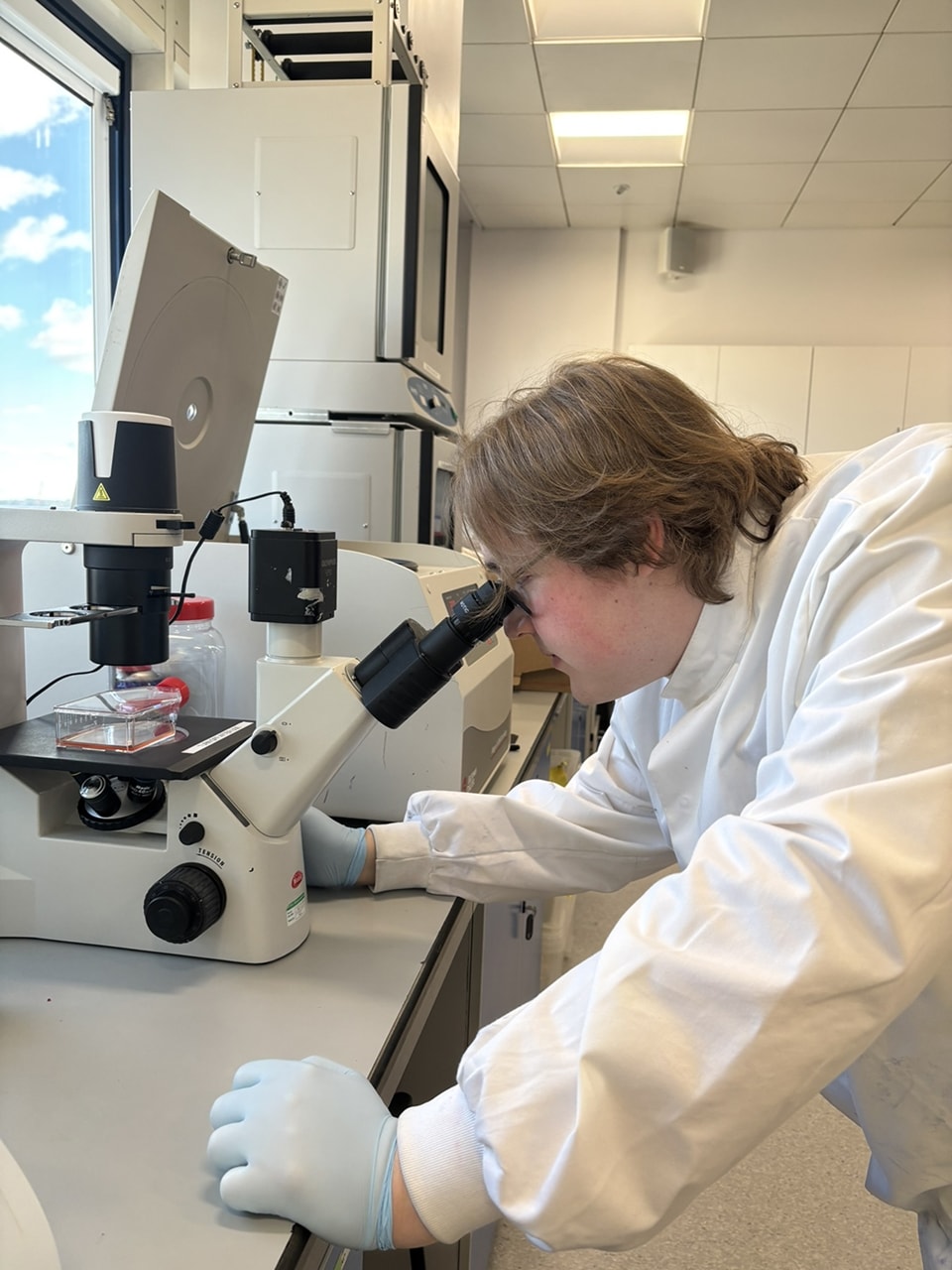
What inspired your interest in this area of research, and why is it particularly meaningful to you?
I knew I wanted to work in cancer research since secondary school when I lost my mum to cancer – this has driven my passion for cancer research. After school I did a BTEC level 3 in Applied Science and tailored this to the biology side, followed by my undergraduate degree in Biomedical Sciences at Anglia Ruskin University. It was there that I found out how big the field of cancer research is, and how driven I was to be involved.
After my degree, I spent a couple of years working in industry for a biotech company called Abcam. This gave me the skills to hit the ground running with my PhD. My career so far has been a zigzaggy line – it doesn’t matter if it’s not a straight line, as long as you get to your end goal. No one is going to cure cancer with a PhD, but if I can just make that small bit of difference then that’s what matters to me.
I felt a bit restricted in industry, whereas the PhD gives me the freedom to explore what I think is important. I also did some lecturing at Anglia Ruskin whilst working in industry and loved that – so I want to stay working in academia after my PhD.

Can you share a standout experience from your work in the industry or research so far, and how it has shaped your PhD journey?
There is a technique in the industry called Western Blot. If you think of the inside of a cell as a soup - you have to break it open and separate the elements to look for a specific protein. As part of the process, you usually boil the samples to help them separate. I had been trying to find a specific protein for a couple of months and had tried everything before managing to separate them by not boiling the sample. This showed me that, when something goes wrong, it’s important not to give up. And also to try changing one thing at a time – starting from something simple and then working up. It changed my train of thought for approaching problems in the lab.

'Electrophoresis Gel - This is an image of the first part of a western blot in which we use a gel to help separate out the individual proteins.'
How did you find the studentship opportunity and what was your experience of the application process?
I had a lecturer from my undergraduate degree who I kept in touch with, as I knew I wanted to do a PhD. He signposted me to this opportunity and it really resonated with me. I was invited to an interview a month and a half after submitting my application, and I came up to Leeds to meet everyone in person, including my supervisor Professor Jim Boyne. We talked about what I had done in industry and my undergraduate project. It wasn’t my first PhD interview, so I knew that it wasn’t just about them learning about me – but also me learning about who I would spend the next three years working with. I felt that Jim was more interested in me, and how I would progress throughout the project – and not only how the project itself would go. Everyone was so helpful, and it was one of the nicest interviews I’ve been to. Two weeks later, Jim called to let me know I had been successful, and I was so relieved! I had been trying to secure the right PhD for the best part of two years.
Before I started, I had no experience of the techniques relevant to EVs. So my advice to others would be – even if you don’t have direct experience of something, you should still go for it, but explain how what you know can be tailored to what you don’t know. I had done similar techniques at Abcam, and built up a repertoire of problem solving and critical skills. Don’t be afraid to say you don’t know – being truthful and open is highly valued.
What practical steps or resources would you recommend to others searching for funded research opportunities?
If you have a tutor from your current or previous degree, don’t be afraid to ask them if they know anything out there, or there is someone they know leading a project. This is how I found my opportunity.
Find a PhD is also a fantastic resource. You can search for topics and filter whether they are funded or not, see who the supervisor is, etc. If you like the sound of a project, don’t be afraid to reach out to the Principal Investigator before you apply. Have a quick Teams meeting, see if you like them, and find out more about the project. It shows you are willing and might be the 1% that makes a difference in an interview.
If you don’t get an interview, don’t be disheartened. They are competitive and sometimes it can feel like luck. Persevere, and you’ll eventually end up getting there!
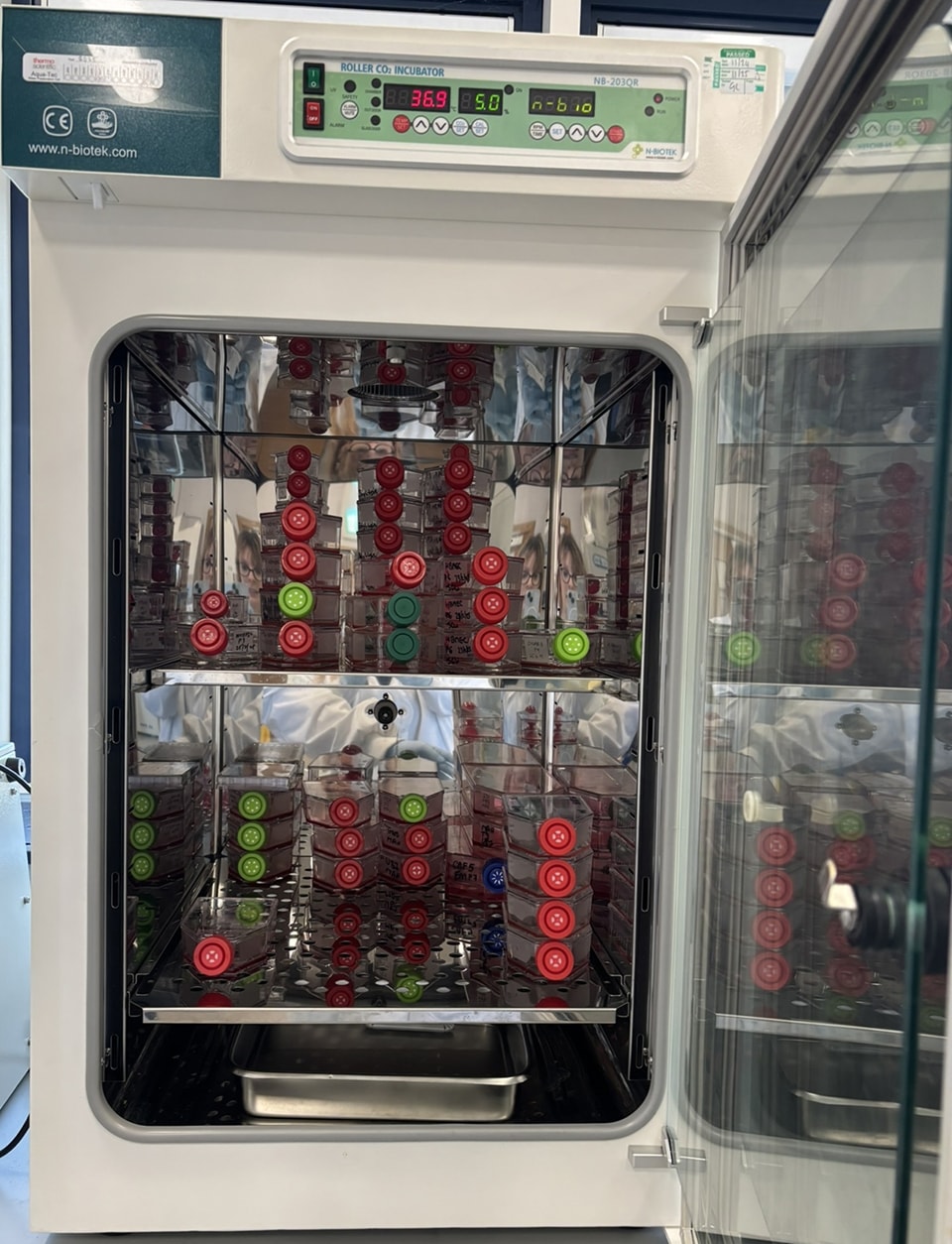
'Cells in the incubator - This is an image of how human cells are grown in the lab! It’s kept under very specific conditions to allow the cells to be happy and healthy.'
What are the unique challenges – and benefits – of working with a charity or funder?
When a supervisor applies for a grant for a PhD student with a charity or funder, they set out the overarching question that they want to answer through the project. So, you need to make sure throughout the PhD that you’re answering that question. Then you can delve deeper into the nuances. Initially, this can be more restrictive.
On the other hand, a lot of people starting a PhD can take some time trying to work out their outline and direction, and with a studentship you have a good starting line. So, it depends on how you look at it – it can be both helpful and a bit restrictive.
As well as answering the research question, the British Skin Foundation also require a published paper on the project so that we can share the findings with a wide audience.

How has support from your supervisor and the biomedical sciences team at LBU helped you in your research journey?
Even though I come from an industry background, learning new techniques can feel overwhelming. Jim has been brilliant – he can tell when my brain is going haywire and can help me to focus and break things down one step at a time.
The other PhD students in my lab are a great support network. There is one person a year ahead of me, one who is two years ahead, and one who is a research assistant who has just finished their PhD. It is great to speak to them and draw on their different experiences and there is dynamic of not being afraid to ask for help.
A PhD is still a training programme – you’re building your skillset and learning how to become a scientist. Even across other groups that my supervisor doesn’t look after, we’re all in the lab together and will share opinions and look at problems slightly differently using our different pockets of knowledge.
What advice do you have for new PhD students starting out on a studentship or considering a studentship?
In STEM-based subjects in particular, don’t expect everything to work first time in the lab! 90% of the time it won’t, and 10% it will – it’s being able to look at something that doesn’t work and figure out what you are going to change. You can spend the first three months just finding your feet in a new lab.
You’ll be gunning to start and get on with your research – but take time to adjust. Three years is both a short and long time so settle in, do some reading, and get used to where everything is in the lab. Don’t expect to immediately start generating loads of data – your supervisor doesn’t expect it, and it’s not what you should expect.
Find out more about our Centre for Biomedical Science Research at LBU.
Have you considered pursuing a studentship? Let us know your thoughts or questions below.

Jacob Gillett-Woodley
Jacob Gillett-Woodley is a Biomedical Sciences PhD student in the School of Health, funded by the British Skin Foundation. Jacob’s project is focused on skin cancer and the spread of melanoma to the brain.





