
Leeds Beckett University - City Campus,
Woodhouse Lane,
LS1 3HE
Stories
LBU Research Voices at Graduation – From BSc to PhD with LBU!
Welcome to LBU Research Voices, a blog series that celebrates the experiences, journeys, and expertise of our LBU research community. Through this series, we’ll explore the knowledge our researchers have gained - not just from their work, but from their lived experiences, career paths, and the communities they engage with. By sharing their stories, we hope to inspire learning, reflection, and connection across our LBU research culture.
In our Graduation 2025 special edition, we met up with Dr Lucy Eldred, who has just graduated with a PhD in Critical Psychology from our School of Humanities and Social Sciences. Lucy tells us all about her LBU journey from undergraduate to Dr, her experience of working here as a Graduate Teaching Assistant and Research Assistant, and her aspirations for using her research into changing young masculinities to create impact for men’s charities.
Stories

Hi Lucy, congratulations on your graduation! Can you tell us a bit about your PhD and what motivated you to explore this topic?
My PhD explored whether (young) masculinities are changing; there's a lot of conversation around the younger generation being more progressive, and perhaps more open to gender fluidity, so I wanted to explore what this then might mean for masculinity. Following the logic, it would suggest that masculinity may also be becoming more flexible and fluid for some, or at least people would be more accepting of that.
I am motivated by gender equality, so if we are seeing some of these changes in masculinity, does that then have an impact on the everyday lives of young men and their ability to show emotions, be more sensitive, caring, engaged with traditionally 'feminised' practices (e.g. painting nails) without this then having social consequences or carrying stigma? And if we are seeing some of these changes, what does this mean for women and those of other genders? How do genders co-exist without the traditional template of gender and gendered expectations? For this reason, I did not just look at the perspectives of young men across my studies, but men, women, and those who identify outside of the gender binary.
What did it reveal that felt especially important or surprising?
What I found most interesting was that there's still a big disconnect between these conversations I noted above, about young people being more progressive on a lot of fronts, and the actual lived experiences of young people. I recruited between the ages of 16-25, and particularly those just out of school and in college (16/17) noted how their experiences were still heavily shaped by more 'traditional' understandings of gender, and there were social consequences for transgressing many of these expected understandings.
I also found it interesting how a lot of young women and those who identified outside of the gender binary were really encouraging of young men opening up about their feelings/emotions/mental health a lot more, but young men still often experienced barriers to this and felt often unable or unsupported in doing so.
What was it like to work with young people on such a personal and socially important topic? Did anything shift in your thinking as a result?
I really loved it. All the young people that I spoke to or who completed my qualitative questionnaire offered really interesting accounts of their experiences; I guess the good thing about the research topic is that everyone has some kind of experience of masculinity, whether lived or relationally!
At points it did make me a little sad that it seems like there is such a desire for change, but a powerlessness in being able to enact any given change, as it feels tough being one individual amongst a much larger societal structure. I'm not sure what shifted in my thinking, perhaps realising social progression is very, very slow!
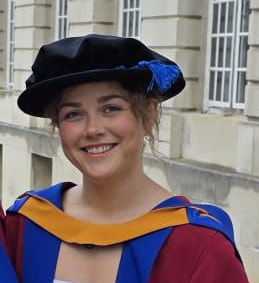
Dr Lucy Eldred (right) with Dr Lucy King (left), at their PhD graduation
You’ve studied at LBU across three degrees - what has kept you here, and what moments stand out when you look back at that journey?
LBU has been great for me and my area of Psychology (Critical Psychology). The staff in the Psychology department have always been really friendly and generous with their time, and have conducted such interesting research in their own fields - it's been a great environment to learn in. What stands out to me is feeling like I was supported and part of a team, particularly in the PhD years.
I chose to stay with LBU for all three of my degrees because the department was suited to the research I do, and the team available were also really desirable in terms of expertise and experience.
What does graduation mean to you?
Graduation to me means celebrating with the people that were part of the journey in getting me to this point. It's a nice closing of a chapter!
How did your time as a Graduate Teaching Assistant (GTA) and Research Assistant help shape your development as a researcher and educator?
Working as a GTA felt a bit strange at first, having been an undergraduate at LBU not too many years before! It taught me a lot about what goes on 'behind the curtain' and how student-focused the approach is at Beckett, which is what I've gone on to take into my current role as a Lecturer at another institution.
My research assistant roles have given me more confidence in being part of a team and of my contribution to projects. And I have always really enjoyed working with people and hearing about their experiences!
What are your aspirations now that you’ve completed your PhD, and what kind of impact do you hope your work will have in the years ahead?
I hope to get back into the research side of things soon, and I would love to work with men's charities to help inform some of their impactful work in the future.
Looking back, what was the most helpful piece of advice or support you received – and what would you say to others navigating the ups and downs of the PhD journey?
I'm not sure if it's advice I received, or something I figured out along the way! There may be many (many) ups and downs of completing a PhD, so it's really important to have other people around you doing the same thing, or who have done the same thing, because they will be the best people to understand you and rally you when things are a bit tough. Having good colleagues, supervisors and peers/friends who are doing the same thing was invaluable to me. And ultimately, it will get done, even if both the journey and the end product ends up looking a bit different to how you first envisioned it!

Dr Lucy Eldred
Dr Lucy Eldred graduated with a PhD from our School of Humanities and Social Sciences in 2025. Her PhD in Critical Psychology explored whether (young) masculinities are changing.





