Leeds Beckett University - City Campus,
Woodhouse Lane,
LS1 3HE

KTPs Go Green: Behind the Scenes of ReGeneration Earth Conference 2025
In 2023, Leeds Beckett University partnered with Aquatrust Water and Ventilation Limited on an exciting Knowledge Transfer Partnership (KTP) project focused on innovative solutions for water monitoring and sustainability, led by KTP Associate Christina Thompson-Mountford. Alongside her, fellow KTP Associate Habiba El-Gharably began a project last year with NuGreen Ltd, working to transform healthcare waste into low-carbon construction materials.
Recently, Christina and Habiba attended ReGeneration Earth 2025, and in this post, they share their insights from the conference, reflections on their panel discussions, and what they’ve learned about driving real-world impact through innovation, sustainability, and collaboration in their KTP roles.

What is ReGeneration Earth all about, and what made you want to go this year?
In June we attended the ReGeneration Earth Conference, which focused on some pretty urgent issues our planet and society are facing. The event wasn’t just about talking problems but exploring fresh ideas to regenerate our environment, society, and economy. It highlighted how the UK, in particular, is dealing with major challenges like biodiversity loss, widening inequality, and economic decline. The whole vibe was about finding creative, community focused solutions to build a healthier and more balanced future. It felt less like a typical conference and more like the start of a movement.
Christina: I first heard about ReGeneration Earth when I was invited to join a panel as a youth voice, which was a really exciting opportunity in itself. But after doing more research into the event, I realised how closely it aligned with my current KTP and with Aquatrust’s commitment in adopting more sustainable practises. The conference covered a wide range of topics, which really got me thinking about the bigger picture of what sustainability means. Being there gave me the chance to meet and learn from people who are equally (if not more) passionate about sustainability, and it sparked some great conversations and ideas that I’m excited to bring back to Aquatrust.
Habiba: I first heard about it through the KTP team at Leeds Beckett University. They suggested it would be a great opportunity for me to not only attend, but also to take part as a speaker, especially as some of the panels aligned closely with my KTP project. That’s what really encouraged me to get involved, the chance to connect with others working on similar challenges.

Habiba speaking at her panel session
What was your panel about, what did you cover during the discussion, and did any interesting comments come up afterwards?
Habiba: I was invited to speak on the “Waste to Wealth” panel, which was such a fantastic experience. It focused on turning waste streams into valuable resources, something that’s right at the heart of my project. It was inspiring to share the stage with people working on innovative recycling technologies with different waste streams.
I introduced my KTP project then emphasised the shift from “take- make- dispose” to “make-reuse-recycle", turning waste into valuable resources instead of incinerating it. I shared examples of emerging technologies such as sterilisation and shredding machines for clinical waste. I reflected on the risks of fragmentation in local projects, called for collaborative networks to enable scaling, and discussed behavioral change - both in terms of businesses and individuals to segregate waste properly.
One of the key messages that came during the discussion was the importance of collaboration. It was encouraging to see how many businesses, regardless of industry, are working towards the same bigger goals: building a circular economy and complying with net zero goals by 2050. I made a few really promising connections with people whose work either aligns with mine or who are exploring similar challenges in different contexts. I left the conference at the end of the day feeling energised and more confident in the wider relevance on what we are working on.
Christina: The panel I felt most closely aligned with my project, was “Powering Progress: Greentech Innovations and Their Role in the UK’s Net-Zero Ambitions.” This session explored how Greentech is transforming not just the energy sector, but also industries like construction, transport, agriculture, and waste management. The focus was on how emerging technologies are helping businesses cut emissions, use resources more efficiently, and contribute meaningfully to the UK’s net-zero targets. My role on the panel was to speak about how Internet of Things (IoT) technology is being used in the water hygiene industry to reduce carbon emissions. I shared some real-life examples of how smart monitoring systems are helping companies make more informed decisions, reduce energy use, and lower their carbon footprint, all while maintaining safety and compliance.
A few takeaways from the session stood out. One was the idea that sustainable change doesn’t have to come at the expense of business success, in fact, the two can go hand in hand. Another big thing was the importance of data; with the amount of information, we can collect the challenge is turning it into actionable insights. As someone pointed out in the discussion, there’s no point gathering data if you’re not going to use it to drive meaningful change.
We also discussed how digitalisation and tools like AI will play a crucial role in the path to net zero, while recognising that this also raises questions about transparency and environmental trade-offs. Overall, the panel reinforced that staying agile, upskilling and embracing innovation are all essential if we are going to tackle the climate crisis, and that green tech isn’t just a trend, but a rapidly growing sector that’s here to stay.

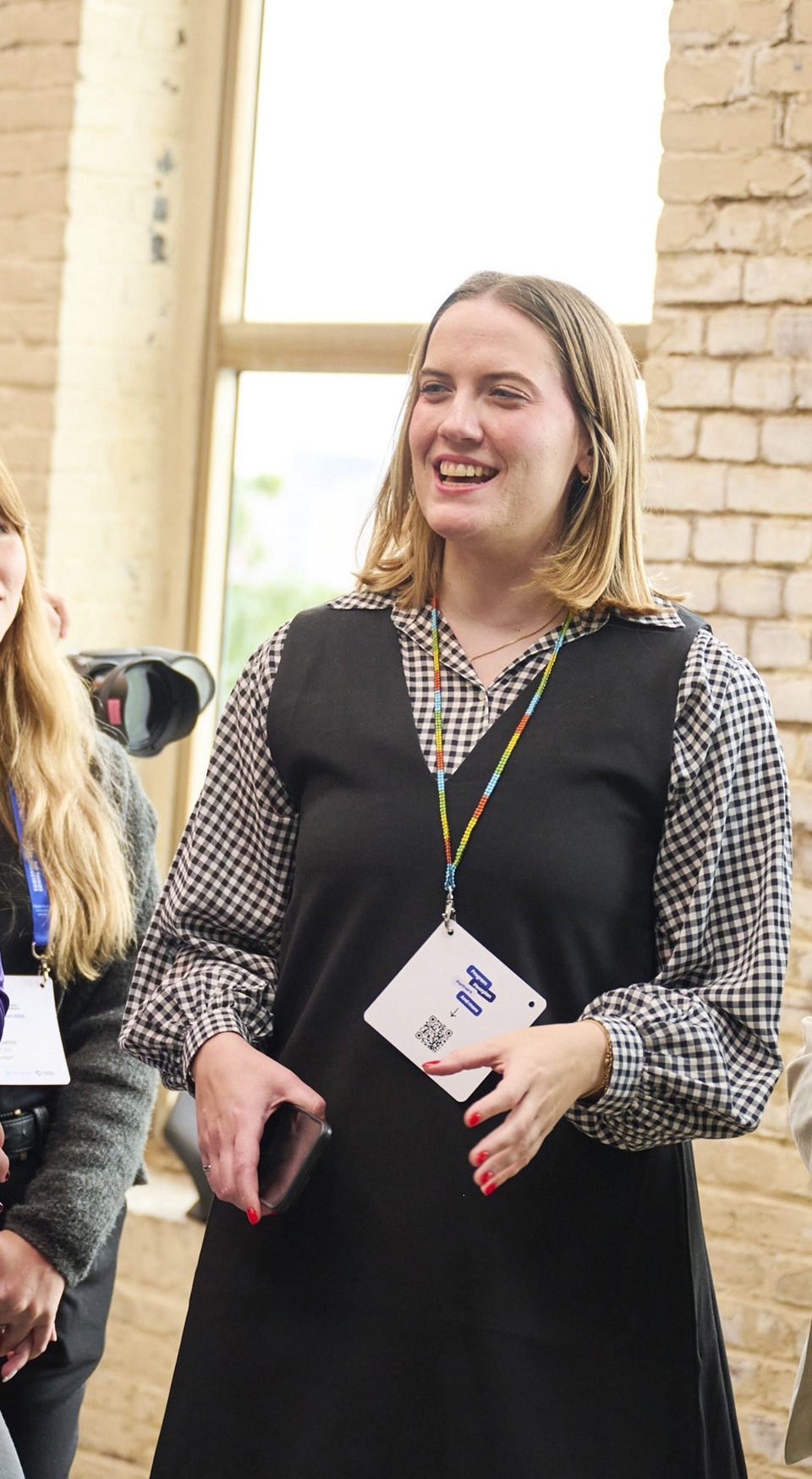
Christina speaking at her panel session
How does your project contribute to environmental sustainability?
Christina: While the primary aim of my project is to improve the efficiency in Legionella monitoring through remote systems, it has a clear environmental impact. By replacing traditional manual temperature checks with a remote monitoring regime, we’ve significantly reduced the need for flushing outlets, saving approximately 108,000 litres of water per year across a multi-site client. In addition, the shift has cut down travel and site visits, contributing to a reduction of around 49 tonnes of carbon emissions. So, although the project wasn’t originally framed as a sustainability initiative, it’s delivering tangible environmental benefits.
Habiba: My project is all about finding more sustainable ways to deal with healthcare waste. By exploring how this waste can be safely processed and repurposed into low-carbon construction materials, we’re aiming to reduce the environmental impact of both the healthcare and construction sectors, which are among the most carbon-intensive industries. The NHS in England produces approximately 156,000 tonnes of clinical waste annually which is sent to high temperature incineration or alternative treatment. Imagine that some of this massive amount of waste is turned into something useful, helping to close the loop and support a circular model of production and consumption. This approach could help cut down on raw material extraction and lower emissions.
For anyone who’s never heard of a KTP – what actually is it, why did you decide to get involved, and what’s it been like making that jump from uni into the real world of industry?
Habiba: KTP stands for Knowledge Transfer Partnership, and it is a UK programme supported by Innovate UK that encourages collaboration between businesses and academic institutions to promote innovation. Through these partnerships, companies gain access to specialised academic knowledge, helping them develop new products and services.
What really drew me to the KTP was the chance to work across both academia and industry. I loved the idea of not having to choose one path over the other but instead gaining experience from both sides. On one hand, I get to work closely with experts at the university and stay connected to research and academic thinking. On the other, I’m part of a live business environment, seeing how ideas are applied in practice and how decisions are made in the real world. It’s honestly the best of both worlds.
Making the jump from uni to industry has been a learning curve, suddenly I'm not just working on a project for a grade but delivering something that will have a real impact. There’s more responsibility, but also more opportunity to grow and contribute. I’ve learned so much already, from technical skills to understanding how businesses operate and make decisions. It’s been challenging at times, but also incredibly rewarding.

Can you share any tips for someone thinking about applying for a KTP?
Christina: Definitely! A KTP is a great stepping stone if you’re looking to apply your academic knowledge in a real-world setting while developing professionally. Our advice would be to go into it with an open mind and a willingness to learn on the job, you’ll pick up a huge range of skills beyond your core expertise. It’s also a unique opportunity from training and personal development opportunities to building confidence, growing your network, and taking real responsibility early in your career. If you’re someone who enjoys solving problems and wants to make a solid impact on an industry, it’s a brilliant next step.
What kind of skills have you picked up during the KTP – and how did speaking on a panel at a conference support this?
Habiba: Honestly, I’ve picked up so many valuable skills since starting the KTP. One of the biggest areas of growth has been communication, especially presenting. I present to the company once a month to update them on the project’s progress, and that regular practice has really helped me become more confident speaking in front of different audiences. It’s also helped me get better at translating technical ideas into something clear and engaging for people from different backgrounds. Being on the panel at the conference took that to another level. Speaking at a public event was outside my comfort zone at first, but it really boosted my confidence. It taught me how to respond on the spot, think quickly, and engage in meaningful discussions.
Christina: As part of my KTP, I’ve had the chance to take part in presentation and media training, as part of my personal development plan. I was able to put the skills I learned in those sessions to good use during the panel, like techniques to calm my nerves and storytelling methods to make my points more memorable. Although I’ve had public speaking opportunities before through the KTP, being on a panel introduced a different dynamic that really pushed me out of my comfort zone in a positive way. It was a great experience to build on what I’d learned and gain new confidence.

Habiba speaking at her panel session
Has this whole experience changed how you see innovation and sustainability?
Christina: Yes, this experience has changed how I view both innovation and sustainability. At university, sustainability wasn’t always a core focus in projects, it was often treated as a separate topic rather than something that could be integrated into everyday problem-solving. Since starting my KTP, I’ve had to explore a range of case studies and real-world examples where innovation and sustainability go hand in hand. It’s shifted how I approach challenges and helped me see that sustainable thinking should be embedded from the start. If higher education encouraged students to think with an innovative and sustainability-focused mindset from early on, I think we’d see far more creative, impactful solutions coming out of the sector.
Habiba: Definitely. I’ve always been passionate about sustainability; my dissertation project was on cement-free concrete, but this project has made me realise just how much every decision matters. One big shift for me has been realising how much the small decisions matter. Whether it’s choosing a material, planning a process, or thinking about end-of-life use - every step has an impact.
Find out more about KTP at Leeds Beckett on our website. KTP aims to help businesses to improve their competitiveness and productivity through the better use of knowledge, technology and skills that reside within the UK knowledge base. This successful Knowledge Transfer Partnership project, part-funded by UK Research and Innovation through Innovate UK, is part of the government’s Industrial Strategy.


Christina Thompson-Mountford
Christina is a KTP Associate, working on the Knowledge Transfer Partnership between Leeds Beckett University and Aquatrust. She is a graduate of LBU’s BEng Robotics and Automation degree and is passionate about using technology to solve real-world problems and drive innovation.
You can connect with Christina on LinkedIn here.

Habiba El-Gharably
Habiba is a KTP Associate, working on the Knowledge Transfer Partnership between Leeds Beckett University and NuGreen Ltd. Habiba is exploring the utilisation of healthcare waste as a low-carbon construction material to help decarbonise both the healthcare and construction sectors. She’s a graduate of LBU’s BEng Civil Engineering degree and is passionate about driving forward sustainable practices in healthcare and construction industry.