
Leeds Beckett University - City Campus,
Woodhouse Lane,
LS1 3HE

Welcome to our new Professor of Visual Computing
In June 2024, we welcomed Amar Aggoun as our new Professor of Visual Computing and Head of Computer Science in the School of Built Environment, Engineering and Computing. In this post, Professor Aggoun tells us all about his research – from using AI to identify and predict medical conditions in their early stages, to developing the first single aperture 3d video camera.


Welcome Amar, can you tell us about your career journey to date and what attracted you to LBU?
I grew up in Algeria and I studied electronic engineering at the Ecole National Polytechnique d’Alger (Algiers). Following the completion of my first degree I moved to the UK to the University of Nottingham where I did my PhD in Computer Vision. Since then, I have held various roles in UK universities, namely University of Nottingham, De Montfort University, Brunel University London, University of Bedfordshire, the University of Wolverhampton and now at Leeds Beckett University.
Over these years, I have accumulated significant experience in leadership roles within academic settings, where I have successfully led diverse teams, spearheaded initiatives to enhance the quality of education, foster innovation and interdisciplinary collaboration, and promote research excellence.
I have been an active researcher throughout my academic career with ambitions to deliver high quality research with societal and economic impact This includes developing the next generation of researchers though PhD and Postdoc supervision and staff mentoring, dissemination of research through high quality outputs and generating income through research collaborations with other institutions and/or industry.
I heard a lot of good things about Leeds Beckett University well before I decided to make the move - and I felt then, and still do now, that there is a good match with both my professional aspirations and the values of making a real difference to lives and communities, both locally and internationally.
Tell us about one of your current research projects and how this opportunity came about?
In the last few years, I have been conducting research on the use of artificial intelligence (AI) to identify and predict medical conditions at very early stages. Two of my current research projects look at :1, enhancing the diagnostic precision of anaemia and other common diseases in pregnancy and 2, early prediction of acute kidney injuries post cardiac surgery.
This came about following a meeting with colleagues from health sciences. We then started lto develop a forward-looking, inclusive, interdisciplinary research strategy for health technology research. This led to research collaborations involving major NHS trusts - namely the Royal Wolverhampton NHS Trust, Queens Hospital (University Hospitals of Derby and Burton NHS Foundation Trust), Oxford University Hospitals Foundation Trust, as well as Dubai Health Authorities.
What are your research ambitions for the next few years?
As Head of Computer Science, I have a strong commitment to advancing research within Leeds Beckett University. This includes securing external funding, supporting staff in their pursuit of cutting-edge research, and engaging with stakeholders to ensure knowledge gained from research is used for the benefit of the economy and society.
With digital technologies impacting significantly on many social and economic sectors, I am eager to build interdisciplinary collaborations with staff across schools to further enhance the university's reputation for innovation, education and research excellence.
What has been your career highlight to date?
There are many career highlights. From a research point of view, a highlight was securing a large amount of funding for my research in computer vision which enabled me to work with collaborators from around the globe to advance 3d imaging technologies. I also received the 2017 Institute of Engineering and Technology (IET) Premium Award for the best paper in biometrics.
As a manager, I led academic units in computer science and engineering to deliver significant enhancements in student satisfaction - by integrating entrepreneurship and innovation into the academic curriculum. This provides students with the practical skills and knowledge essential for success in the ever-evolving global business landscape.

The single aperture 3d video camera, developed by Professor Aggoun
What attracted you to the computing profession?
I have always enjoyed solving mathematical problems since my early years in secondary school - hence my research started by developing computer vision algorithms as well as their real-time implementation specifically addressing low power devices.
I then expanded the work to address the capture, processing and representation of the 3D world using a single aperture vision system that mimics the fly’s eye, which is made of multiple tiny lenses as opposed to the human eye which is made of a single lens.
This work received worldwide recognition through numerous media reporting and invitations as guest/keynote speaker/exhibitor at several conferences and exhibitions. It led to several awards including funding from UKRI, the European commission and industry cumulating in several collaborative research projects involving multi-company and multi-research institutes within the UK and around the globe.
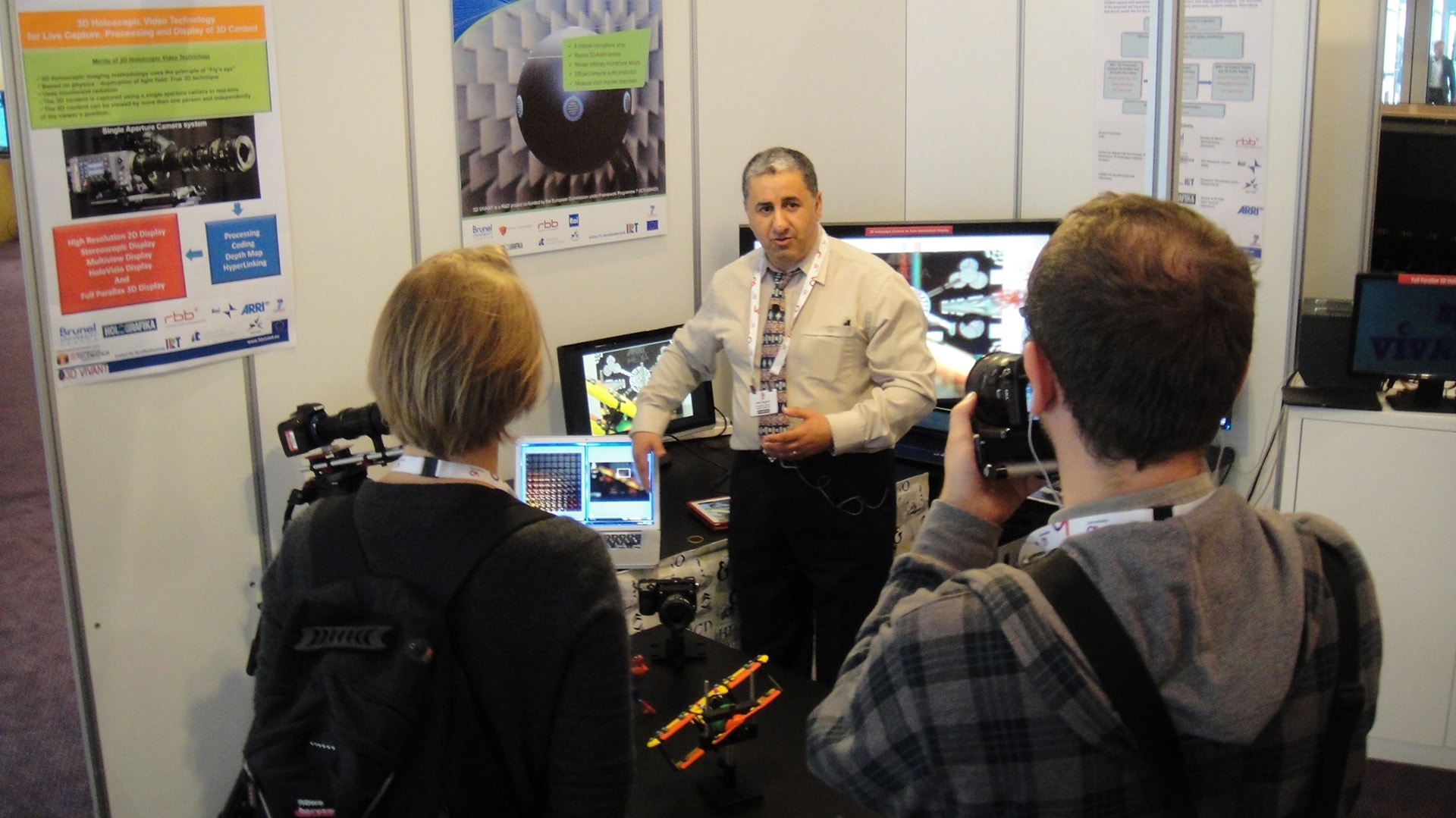
Particularly I was the principal investigator and manager of the 3D vivant project - funded by the European Commission and in collaboration with ARRI Cine Technik GmbH and Co - we developed the first single aperture 3d video camera.

An image of Professor Aggoun captured using a single aperture 3d vision system - and the recovered central view
Can you tell us something about yourself that we may now know?
I am married with children. I love cooking and try to learn and cook food from various parts of the world. My other interests are football, music and comedy.

Professor Amar Aggoun
Amar Aggoun is Professor of Visual Computing and Head of Computer Science in the School of Built Environment, Engineering and Computing at Leeds Beckett University.





