
Leeds Beckett University - City Campus,
Woodhouse Lane,
LS1 3HE

Why Pain Sticks: A New Integral Vision for Understanding Chronic Pain
For the past year, I’ve been immersed in a challenging but rewarding journey: bringing together a wide range of disciplinary perspectives to create a more integrated understanding of pain. The result is a newly published article titled “Reconfiguring Pain Interpretation Within a Social Model of Health Using a Simplified Version of Wilber’s All Quadrant All Levels Framework: An Integral Vision.” And yes—the article is a bit of a monster in size!


At its core, the paper is an attempt to shift the paradigm in how we think about pain. Despite decades of biomedical and psychological treatments, chronic pain remains stubbornly prevalent—a phenomenon known as the treatment-prevalence paradox. The biopsychosocial model, while widely accepted, has often been applied in fragmented and decontextualised ways, limiting its effectiveness in real-world healthcare.
To address this, I turned to Ken Wilber’s All Quadrants All Levels (AQAL) framework—a model that maps human experience across four key perspectives: the internal and external, both individual and collective. By applying a simplified version of AQAL to pain, I was able to map pain-related experiences and coping strategies across these quadrants, while also considering levels of psychological development.
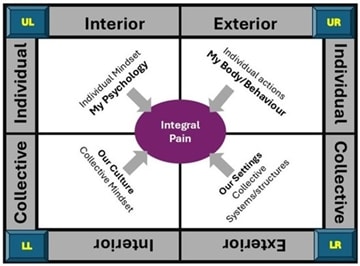
Ken Wilber’s All Quadrants All Levels (AQAL) framework
The findings were illuminating. This approach helped expose a major conceptual error: the tendency to reify pain—as if it were a fixed, objective entity. Instead, the AQAL framework revealed how pain is shaped by complex, interacting factors, including social environments, cultural narratives, and personal meaning-making. It also highlighted the “painogenic” nature of many modern environments—contexts that actively contribute to the persistence of pain.
This work aligns with Leeds Beckett’s partnership with the community-based pain support service called Rethinking Pain and supports a shift toward a whole-person, whole-system, health-promoting (salutogenic) model of care. While this first attempt at an integral model of pain is far from perfect, it opens the door to new ways of thinking—and hopefully, new ways of healing.
If you’re curious, the full article is now available here, and there’s also a short 3-minute video abstract to give you a quick overview.
Big steps in scholarship are rarely easy—but they’re always worth taking.

Simplified version of AQAL to pain

Professor Mark Johnson
Mark Johnson is Professor of Pain and Analgesia. Mark is an international expert on the science of pain and its management and the world leader on transcutaneous electrical nerve stimulation (TENS). He has published over 300 peer reviewed articles.





