
Leeds Beckett University - City Campus,
Woodhouse Lane,
LS1 3HE

Beyond the Pain: Rethinking Persistence Through an Integral Lens
Persistent pain continues to challenge our best efforts in health care. Despite decades of progress, many models still fall short—focusing too narrowly on symptoms, missing the broader context of what pain actually means in a person’s life.


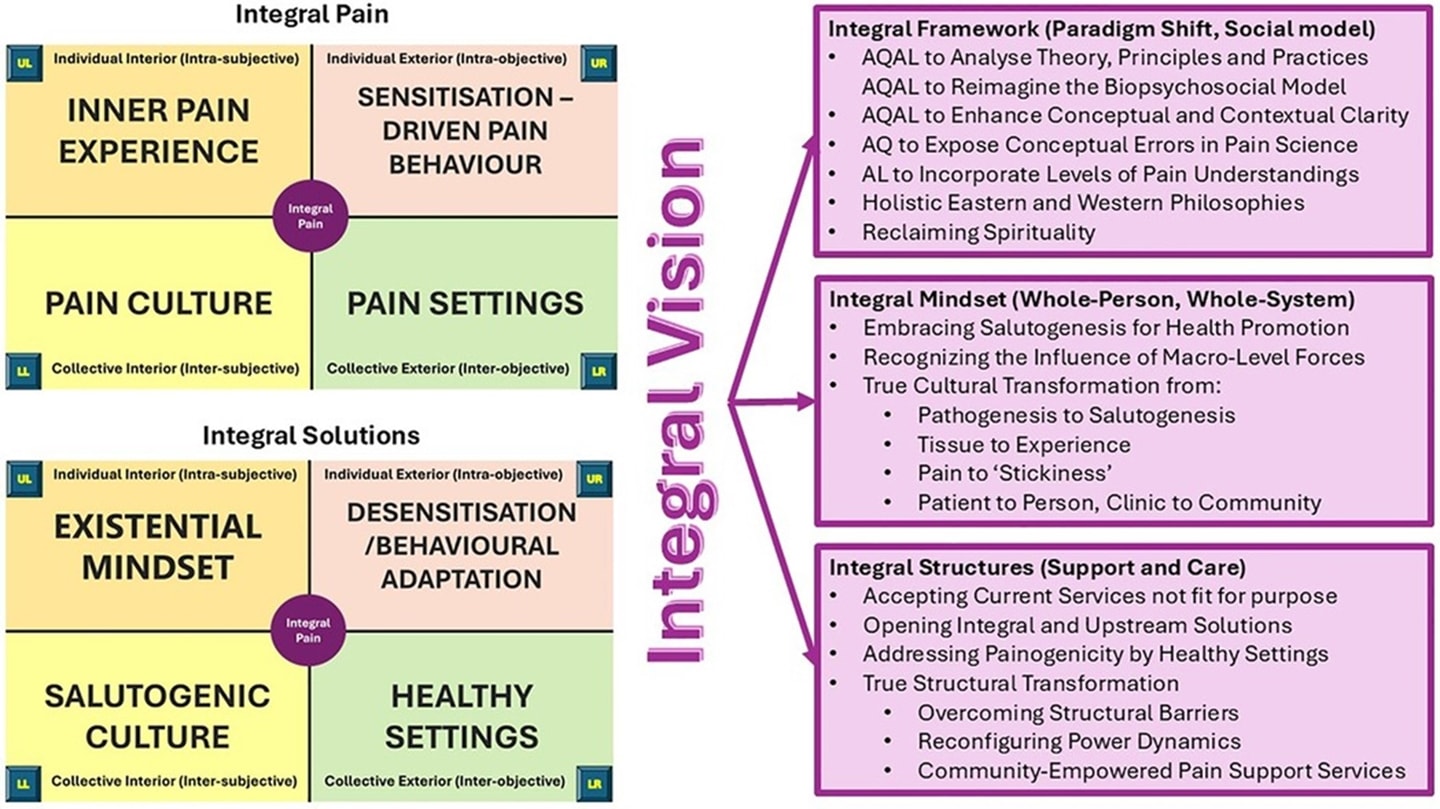
In my latest perspective article titled “An integral vision of pain and its persistence: a whole-person, whole-system, salutogenic perspective”, I build on ideas from my earlier work using a simplified version of Ken Wilber’s All Quadrants, All Levels (AQAL) framework to explore how pain is shaped by a complex interplay of individual and collective dynamics to offer a more expansive and compassionate way of understanding pain—one rooted in an integral vision (previous blog here). This includes psychological development, socio-environmental conditions, cultural narratives, and systemic structures.
The AQAL framework serves as a heuristic tool that allows us to see a much more coherent picture of pain—not just as a biological glitch or clinical symptom, but as a dynamic, relational, and meaning-laden experience embedded in the evolving journey of life.
A key part of this integral vision is recognizing the impact of painogenic environments—contexts that inadvertently sustain or amplify pain—and the role of evolutionary mismatch, where our biology struggles to adapt to modern life. These insights help reframe persistent pain within a salutogenic social model of health, which focuses on what creates health and resilience, rather than just what prevents disease.
This shift calls for a whole-person, whole-system, whole-health approach to care—care that is compassionate, community-driven, and deeply context-sensitive. It’s about empowering individuals to transform painful experiences into purpose, and fostering environments that support psychological growth and meaning-making.
What’s distinctive about this integral vision of pain is its radically inclusive, multidimensional approach that transcends the limitations of traditional biomedical and biopsychosocial models—by integrating subjective experience, objective mechanisms, cultural meaning, spiritual perspectives, and systemic structures. It reconceptualises persistent pain not just as a clinical symptom, but as a dynamic, relational, and meaning-laden experience embedded in the evolving journey of life, ultimately inviting a cultural transformation in how we understand, communicate, and respond to pain—not just treating symptoms, but recognising people, their stories, and the systems they live in.

Professor Mark Johnson
Mark Johnson is Professor of Pain and Analgesia. Mark is an international expert on the science of pain and its management and the world leader on transcutaneous electrical nerve stimulation (TENS). He has published over 300 peer reviewed articles.





