
Leeds Beckett University - City Campus,
Woodhouse Lane,
LS1 3HE

Championing Local Communities to Build Resilience and Learn Fire Safety - Research and Knowledge Exchange Awards 2024
As part of our Research and Knowledge Exchange Awards 2024, we are proud to share a series of blog posts celebrating our award nominees. In this post, Professor Shane Ewen, Professor of Urban History, reflects on his work in sharing stories of disaster and resilience in partnership with community groups, schools and the Fire and Rescue Service – which has led to him winning the Local Champion Award.


I am an urban historian interested in sharing place-based stories of disaster with a focus on learning, preparedness and resilience. My most recent book, Before Grenfell: Fire, Safety and Deregulation in Twentieth-Century Britain, argues that policymakers should learn with as well as from history in improving public safety. It was recommended to the Secretary of State for Levelling Up, Housing and Communities during the Building Safety Debate in the House of Commons.
I have long championed local communities. Since 2018 I have worked with The Old Fire Station at Gipton, which was once one of the busiest operational stations in the country, attending upwards of 400 shouts a year until it was decommissioned in 2014. Having been opened in 1937, its crews fought fires during the Second World War and trained the Auxiliary Fire Service during the Cold War. Along with the Leeds Eastern Fire Heritage Group (LEFHG) and Space2, an award winning social arts charity, we have kept the history and heritage of the station alive so that present and future generations can enjoy this community hub. I was proud to accept the award of Local Champion at the recent Research and Enterprise Awards on behalf of the LEFHG and particularly its founder members who are no longer with us.

The Old Fire Station, Gipton
What inspires your work, and what has been the most rewarding aspect of it?
I am motivated by the thought of inspiring communities to share stories of disaster in creative ways in order to build resilience. Through my Arts and Humanities Research Council funded Forged by Fire project, I have worked with schools and other groups, empowering young people to co-create outputs, ranging from graphic novels to red plaques to commemorate firefighters who lost their lives in the line of duty. We put on public events – including the family friendly Fire Engine Day – to share our research and gather stories from the wider community. Receiving the positive feedback from young people about what they’ve learned about themselves from the workshops is incredibly rewarding. You can learn more about what we do at our YouTube channel or by accessing our creative learning resources.

Trevor Leighton, one of the Leeds Eastern Fire Heritage Group and a retired firefighter, giving a guided tour to our L6 students earlier this semester.
What projects are you excited about that build on this work?
My present project, which is funded by the Heritage Lottery Fund, is a collaboration with the LEFHG to diversify our stories by focusing on trailblazing women in the Fire and Rescue Service. Collaboration with local communities and professional stakeholders is at the heart of the project. We’re sharing stories of inspirational women like Penny Rowntree, who became West Yorkshire’s first female firefighter in 1987 at the age of 18, through community events, school workshops and StoryMaps, to challenge everyday sexism within the FRS and inspire the next generation of firefighters from diverse backgrounds.
I have also partnered with renowned cinematographer Philip Robertson and colleagues in the Leeds School of Arts, and Greenside Primary School in Pudsey, to create a Virtual Reality film based on a historic cinema fire. This is an innovative tool that can be used by teachers and community fire prevention professionals to teach fire safety, resilience and social history to school-age children in an immersive learning environment.
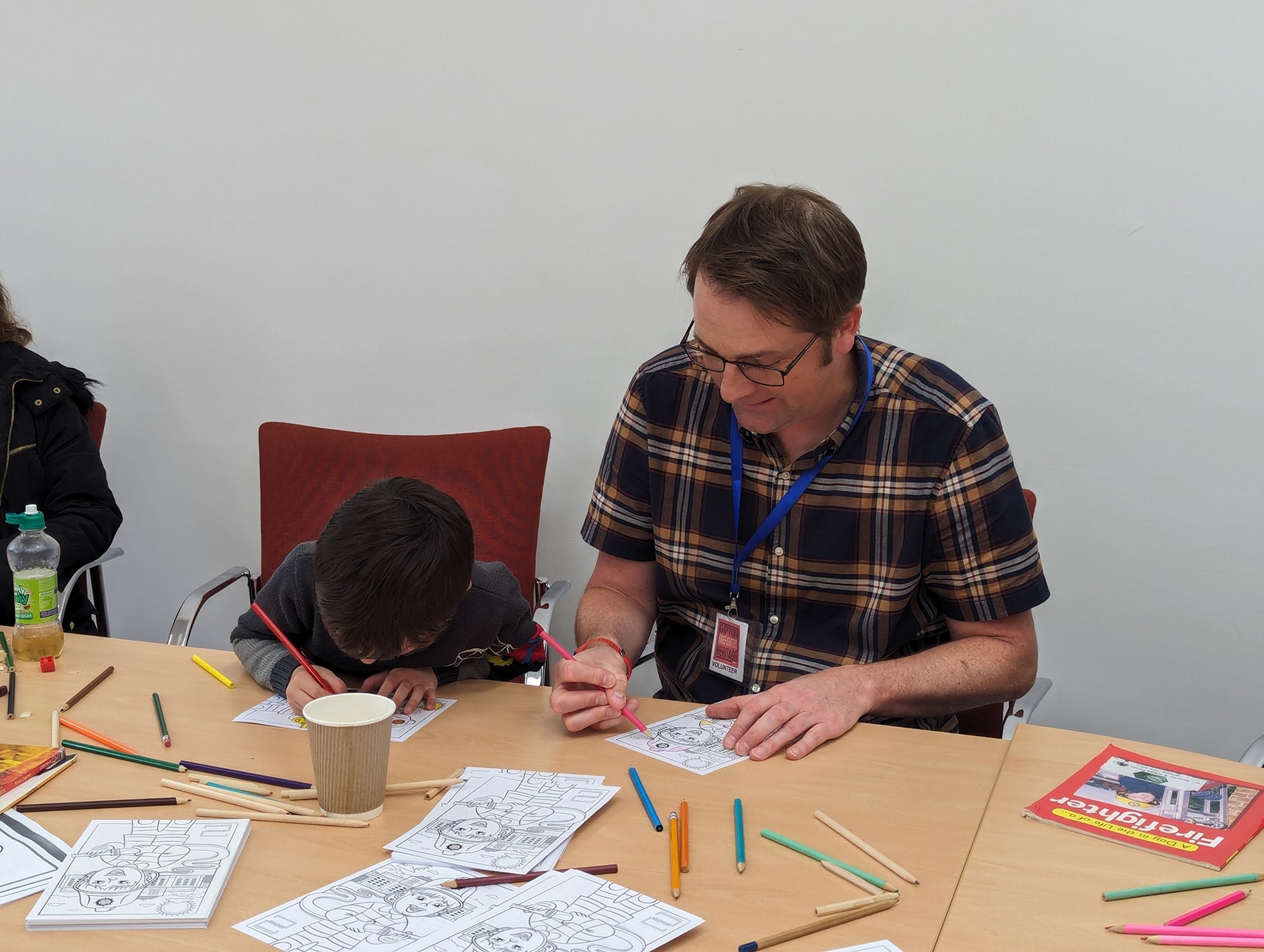
Fire Engine Day 2024
What advice or top tips do you have for others relating to your nomination area?
Community engagement is not a simple process because relationships take time to develop. The conversations are never one-way; collaborative research, much like story-telling, is a two-way process so make sure you listen to your partners’ ideas and use them to strengthen the research.

Children from Holye Court Primary School in Baildon, with make-up on their hands

Professor Shane Ewen
Shane Ewen is an urban historian specialising in 19th and 20th century urban space, identity, emergency preparedness and disasters. He is the author / editor of four books, most recently Before Grenfell: Fire, Safety and Deregulation in Twentieth-Century Britain (London University Press, 2023), which has been highly praised in debates in both the House of Commons and House of Lords. He is co-editor of Urban History (Cambridge University Press), an accomplished public speaker and educator, and a Fellow of the Royal Historical Society.





