
Leeds Beckett University - City Campus,
Woodhouse Lane,
LS1 3HE
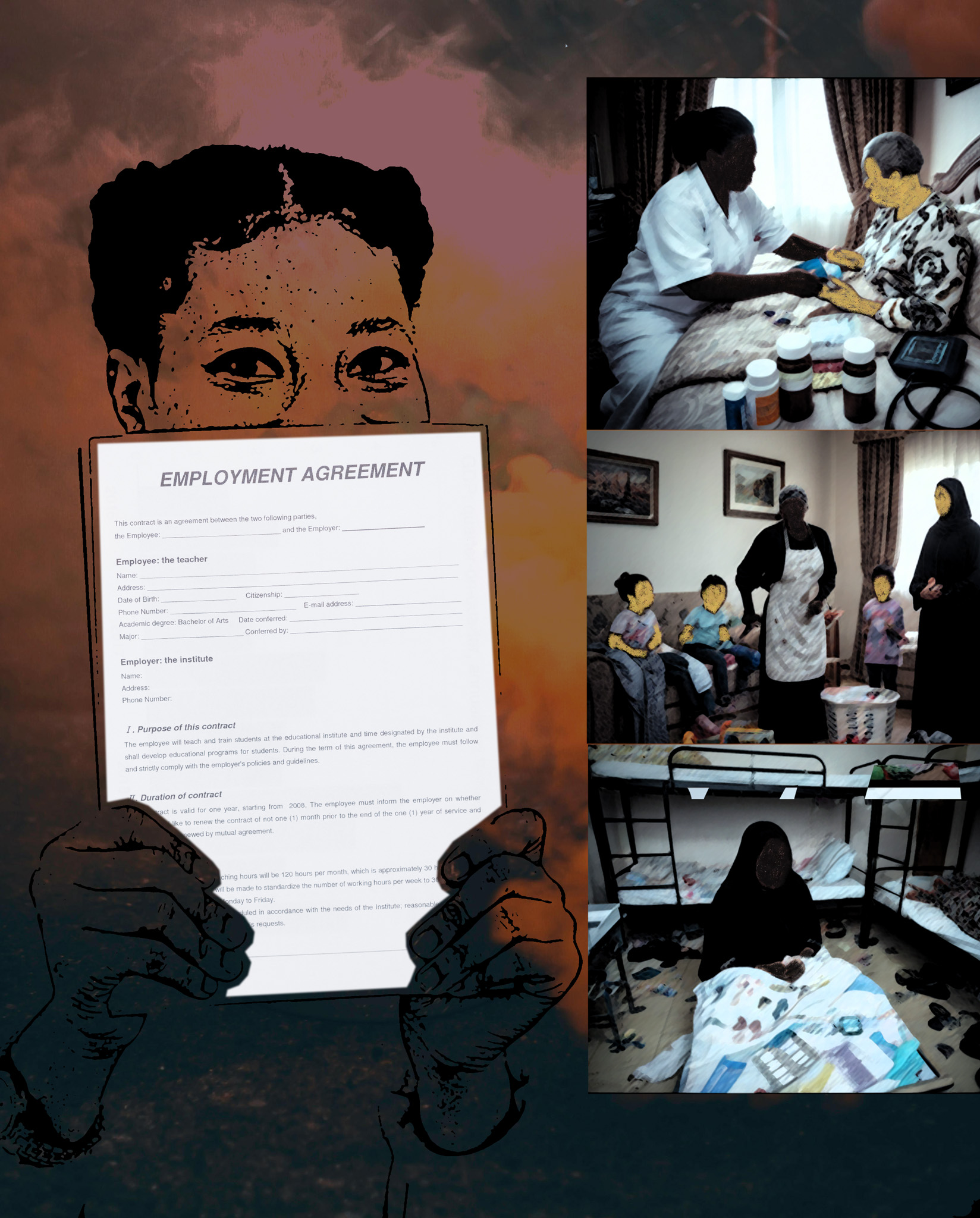
A Journey of Fragmentation
A story about how Nancy's body broke down.
Before I was anything else, a domestic worker, a migrant, a survivor, I was a little girl named Nancy. I grew up in Kisii, where the hills roll soft and green like those you see in a painting, and the air smells of tilled earth after rain. My parents didn't have much, but they gave us what they could: food on the table, discipline, love, and the chance to go to school. I was the second last born in a big family, raised in the sturdy, reassuring arms of both my mother and father. I can still hear my father sharpening his panga at dawn, the ring of metal carrying through the mist, a sound that meant we were safe, provided for. It wasn't an easy life, but it was a whole one. I finished high school with hope in my chest, believing the world would open up to me.
***
At just 18, I met a boy. His smile felt like sunlight breaking through the Kisii fog and I let myself believe it would never set. Love came quickly, blinding and warm. I got married, and with that, my identity shifted, suddenly, I was no longer just a daughter or a sister. I became a wife, a daughter-in-law, a guest in someone else's homestead. And soon, I was a mother. That title alone carries the weight of the world, especially for a woman in Africa, where we are raised to believe that we are the backbone of a home, the invisible glue holding marriages together, the silent strength expected never to break. Some nights, I stared at the ceiling and whispered my own name, just to be sure it hadn't disappeared.
But soon my fairy tale began to crack. The promises faded. The love soured. I found myself back at my mother's house, now with two children in my arms and a new label clinging to my skin: single mother. In many parts of Africa, divorce isn't just a personal event, it is a public failure. A woman who leaves her marriage, no matter the reason, is seen not as brave, but as broken. They look at her children as baggage. Judgments whisper louder than truth. When I walked through the village, I felt their eyes like stones on my back. Even children repeated whispers they didn't understand.
I had mouths to feed depending on me. I was lucky because my parents, despite their limited means, offered to care for my children while I left for Nairobi to live with my sister and search for work. I folded my children's clothes into a small bag, then unpacked them again. Leaving meant survival, but every thread smelled of them. That was the first time I truly felt my identity splitting, like a tree struck by lightning. I was a mother, but now I had to be a mother from afar.
In Nairobi, I pieced together a living. I wrote invoices for a company and I learned to sell clothes for both children and adults on the side. It was enough to survive, but not enough to thrive. My dreams for my children were bigger than hand-to-mouth existence. And so, when a friend told me about job opportunities abroad, it felt like my chance had come.
I scraped together the money to process my documents for travel to Qatar. But betrayal doesn't always announce itself. The first agent I worked with vanished into thin air, taking my hope and money with him. My friend, more fortunate, managed to travel to Qatar and later on to Bahrain. From there, she connected me to another agent. This time, I got a visa within a week. At the airport, I kissed my children's photos until the ink smudged, then boarded a plane full of strangers, my chest hollow with fear and aspiration.
My first job was caring for an elderly couple recovering from surgery. For six months, I gave them everything; my time, my hands, my strength. I fed them, bathed them, and helped them walk again. Though the language was foreign and the culture disorienting, I held on. At night, when I washed their bandages, the smell of antiseptic clung to my skin, but I told myself it was the scent of a better future.
But healing, it turned out, made me expendable. As the woman I cared for regained her strength, the kindness in the house began to rot. Her gratitude curdled into cruelty. She stopped feeding me, told me I was being punished, for what, I didn't know. She said I had chosen to live in her home, as though my presence were some kind of offense. I had nursed her back to life, but now on some nights I lay awake, listening to their plates clatter with food I was not allowed to taste. My stomach crying louder than my voice ever could.
That broke something in me like a glass jar dropped on stone. No one noticed the shards, but I could feel the cuts inside.
At the end of that month, I decided I could not carry on in a house that treated me like a ghost. As soon as I was paid, I left. I reported my situation to the police, and not long after, I was rescued by an organization that helped me process my exit documents. I came back home.
***
The Nancy who returned was not the same Nancy who had left. I had crossed borders, not just geographical but personal identity borders, trust borders, emotional terrain no one prepares you for. In the eyes of the system, I was just labour. Something to be used and discarded. But inside, I was fighting to stay whole. Fighting to remember I was more than what people wanted from me. When I washed my face in the mirror, I whispered, 'Nancy, you are still here', afraid one day the glass would not recognise me.
I used to believe that hard work opened doors. So I took myself through driving school. When I was offered a contract to work in Qatar as a driver, I felt something I hadn't felt in years: momentum. A small, flickering freedom. Behind the wheel, I felt the road hum under my hands, as if at last I was steering my own life.
The visa came in two weeks. Suspiciously fast. I didn't see my documents until the very last minute at the airport, handed to me like a boarding pass into a life I hadn't agreed to. The papers said domestic workers, not drivers. I stared at the word domestic worker printed in bold, my throat tightening as if it were stamped across my skin. When I asked questions, the agent smiled and lied, "They'll fix it on the other side." But nothing was ever fixed.
***
What I walked into was far from livable. My sponsor spoke no English. I spoke no Arabic. Every instruction was a guessing game, every mistake a mark against me. I was promised essentials, food, shoes, toiletries. I received none. My only pair of shoes, tight leather from the journey, burned blisters into my feet under the cruel heat. I limped through work.
I left that house. I had no money, no voice, no health. Just pain. They passed me to another employer like a broom. No explanation. No care. Just instructions. Clean. Cook. Smile. Obey. I worked until I fainted. When I collapsed, no one bent down to help me. I had become part of the tiles. They sent me back to the agency like broken cargo. Not even a full month, not even a single coin in my hand.
The next house was worse. I worked nearly 24 hours a day. Some nights I ironed until my hands shook, the hiss of steam rising long after midnight, my eyes too heavy to stay open. After two weeks, I was shipped back, again unpaid, because the family went on vacation. I was never a person to them, just a tool they put down when not in use.
In the following house, I was told it would be easier. Six children. A large house. Another woman supposedly in charge of the kids. But conditions changed, again. The kids became my responsibility. They were rough and often violent. One child hurled a toy truck at my chest. Another yanked my scarf until I gasped for air. Their laughter echoed through the hall while my hands shook from pain and fatigue. The house was huge and the cleaning and tidying never seemed to end. My legs began to swell, my heart fluttering in my chest. A hospital visit, finally, and I was told I had diabetes and kidney issues. Medication made me dizzy and weak. Still, I was expected to work.
One day, I collapsed at the children's school. The children's eyes stared, wide and curious, while the teachers looked away. I begged my employer to let me return home for treatment. "I'm not refusing to work," I said. "My body is failing." She told me to go to sleep.
That night, I reached out to my agents. The one in Qatar said, "Work for three months first. We need to recover our investment." Their words rang in my ears like a receipt being printed. I was not Nancy anymore. I was only a loss they wanted to recover.
A Kenyan woman at the school had seen me collapse. She pulled me aside one day and whispered an option I had not dared to consider: run. Go to another office. Freedom would cost 1,000 riyals. I wrestled with the choice for a month. Every night I lay awake, hearing the woman's whisper in my ear, my heart pounding so loud I feared it would give me away. In the end, I decided to wait until payday. If I was going to buy my exit, I needed the funds.
When the money came, I ran. Directions memorized, heart pounding, I found the offices. There, a new sponsor was found, an Indian family. I slept on the cold floor of a playroom. My health worsened. Still, I stayed the month to get paid. I couldn't afford to lose another cent. As I ran this time, every doorway felt like a trap, every passing car like it carried my hunters. By the time I reached the office, sweat soaked my dress.
I stayed in cramped housing provided by the new agency, surrounded by women like me, each one surviving on crumbs, each one someone else's discarded worker. We slept shoulder to shoulder on thin mattresses, the air thick with sweat and whispered prayers, our dreams pressed flat against the concrete walls.
Time passed. My body crumbled. I called my parents and told them the hardest thing I've ever had to say: "Don't depend on me anymore." When I said those words, the line went quiet. I could hear only my father's breathing, heavy and pained, before he whispered, "We will manage."
Desperate to numb the pain and silence the guilt, I turned to sheesha and pills. The smoke curled through my chest like false comfort, and the pills blurred the edges of my nights, but the emptiness always woke me again at dawn. I was done. I surrendered myself for deportation.
***
They kept me for a month. My blood pressure was too high to fly. I called everyone I knew. The woman who had taken my passport stopped answering. I was a ghost again, detained and discarded. The days blurred into the rattle of keys and the scrape of plastic trays, each sunrise a reminder that I was still trapped. Eventually, with medication and prayers, I was cleared to fly.
My cousin picked me up from the airport. For two weeks, she nursed me back to something like health. I traveled upcountry. My children, my parents, their faces, reminders of what I had nearly lost.
I had returned with almost nothing. No savings. No papers. No job. But I had breath. And I had my children.
Eventually, someone took me to an organization that offered to pay for my healthcare. Just being seen, being treated, made all the difference. Within a month, it felt like a miracle. My body was no longer fighting me every day. I could breathe without fear. I could speak without breaking.
And finally, I could begin to speak to a therapist, to friends, even to myself about everything I had carried in silence. Piece by piece, I began to return to myself.
***
What I went through in those two years across borders, in rooms where I was ordered, beaten, and abandoned marked me forever. Not just on my body, but in the way I see the world now. My identity was flipped, stretched, and rewritten so many times I nearly forgot who I was. Worker. Cleaner. Cook. Caregiver. Machine. All roles assigned to me by people who never asked me my name.
But I'm Nancy. A mother. A survivor. A dreamer. A woman still standing, still hoping.





