
Leeds Beckett University - City Campus,
Woodhouse Lane,
LS1 3HE
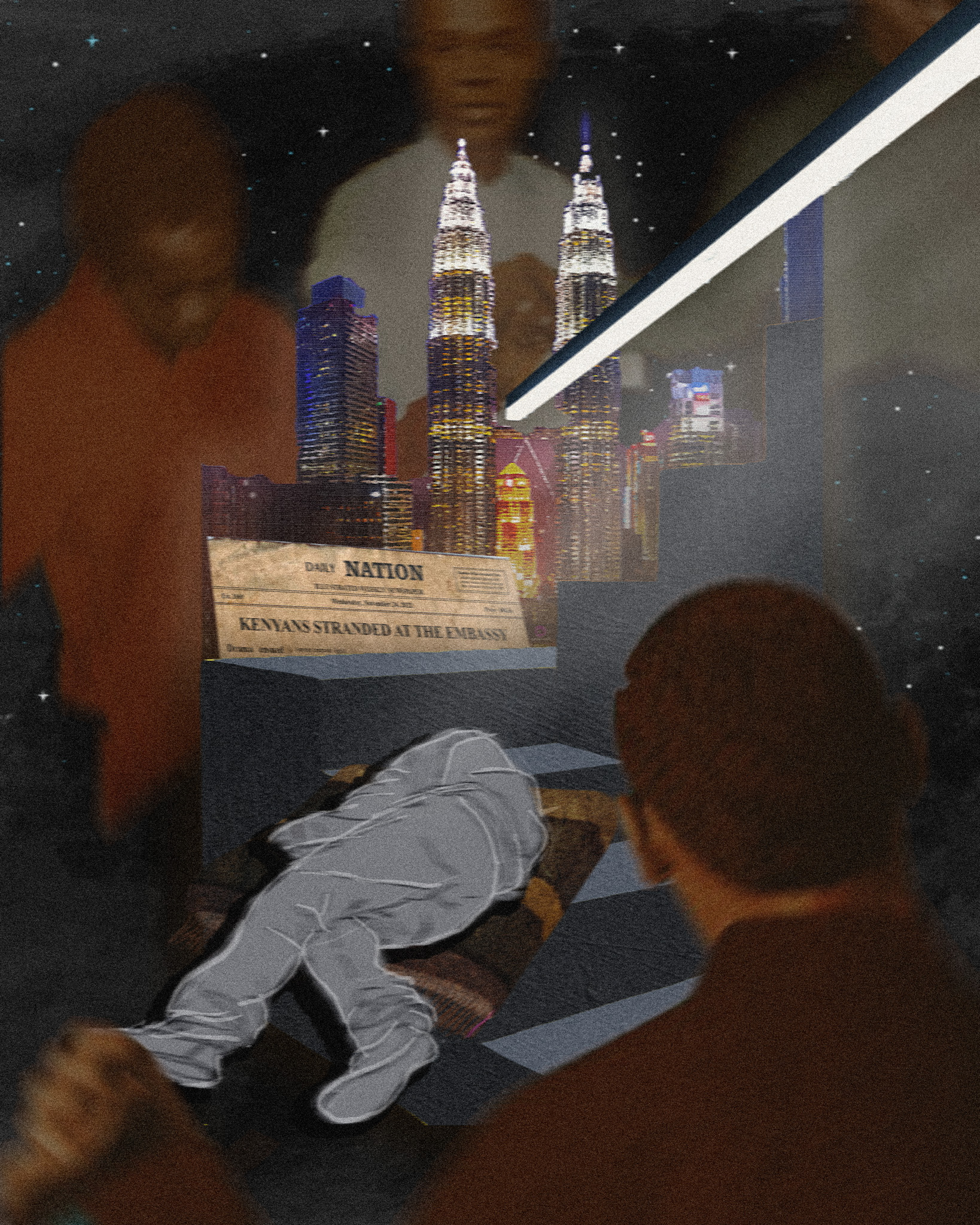
Homeless in the wake of rescue
A story about how a pursuit of a better life led to homelessness for Charles.
Charles, a 29-year-old dreamer with a spark for creativity, lay on a mattress in the rain-soaked corridor of the Kenyan embassy in Kuala Lumpur, his stomach gnawing with hunger. The cold concrete beneath him was a far cry from the vibrant life in Soweto, Kahawa West, where his family's home pulsed with laughter and warmth. Disbelief and betrayal churned within him. Each raindrop on the corridor's floor echoed his fading place in the world. The concrete felt familiar to him, not because he belonged, but because the world offered no softer place. How had his pursuit of a better life led to homelessness in a foreign country, invisible to the systems meant to protect him? Homelessness had eroded his sense of self, stripping away his sense of belonging, leaving him unclaimed by the world. A 3D animation graduate, a son and a brother, Charles carried dreams far grander than the ordeal now testing his spirit. The embassy's indifference, its silent refusal to see him, mirrored the void within: invisible, untethered, a ghost in his own story.
***
"Charles, are you okay?" His mother's voice trembled through a WhatsApp call, heavy with love and worry. Her words, warm as Soweto's sunlit streets, were a fragile tether to home, pulling him back from the edge. But hope felt like a thread fraying under the weight of broken promises. For five months, Charles and other stranded Kenyans sought refuge at the Kenyan embassy in Malaysia, expecting sanctuary, only to be left to sleep on borrowed mattresses under leaking skies, ignored. Each day of neglect deepened his dislocation, a sinking realization that no one was coming to save him. Not today. Maybe never. The betrayal cut deeper than the rain, each drop a reminder of his fading place in the world. Yet, in sleepless nights, Charles clung to memories of home; his mother's food simmering on the fire and the love and laughter anchoring him against despair.
In Soweto, Kahawa West, Charles lived with his mother and two brothers. His father, a distant presence. A higher national diploma in 3D animation from Shang Tao Media Art College fuelled his dreams of creating vibrant worlds, but unemployment in Nairobi crushed his spirit. "I wanted to make my mother proud," He later reflected, "to show her that her sacrifices weren't in vain." Stories of Kenyans working and thriving abroad sparked hope and the desire to try his luck. When a family friend introduced him to Talent Quest Africa, led by its CEO, Chege, Charles saw a path forward. Chege promised Charles a warehouse job in Malaysia, which was a stepping stone to stability. The KES220,000 commission he asked for was steep for Charles, but he was determined to get it. He took a loan to raise part of the money while his mother rallied friends to help. Chege's instructions to Charles to carry $400 extra and pose as a tourist if questioned at the airport, raised red flags. He could feel the version of himself slipping away even before he left Kenya. However, swept up in the thrill of his first trip abroad, he ignored the unease.
He boarded a plane to Malaysia, his heart racing with visions of a flourishing future. He hoped he would rise above the unemployment stifling Nairobi's youth and let him honour his mother's sacrifices. He had imagined Malaysia as an extension of home, not an escape, a place to build a better future.
At Sharjah International Airport in UAE, waiting for his connecting flight, Charles felt a mix of nerves and exhilaration. The airport's bustle was a world apart from Soweto's dusty streets. He saw travellers with Kenyan flag beaded bracelets, approached them, and learned they too had been recruited by Talent Quest Africa. Their shared ambitions forged an instant bond, a fleeting sense of home in a foreign place. But upon landing in Kuala Lumpur, no one came to receive them. They were stranded. Finally, a Malaysian contact that Chege had given them turned up and asked them to pay an unexpected 50 Malaysian ringgit for a night at the Putra Majestic Hotel. The following day, Chege told them to hand over their $400 to a man named Raj in order to secure jobs. Trusting the process, they complied, oblivious to their involvement in Chege's exploitation of the gaps in Kenya's oversight of labour migration recruitment.
Days later, Raj took Charles to a laundry facility, not a warehouse. The bare floor of an empty hall was his 'accommodation'. The pit latrine was a filthy shock. Lying on that concrete, the cold seeping through his thin shirt, Charles closed his eyes, visualizing his room in Kahawa West. He thought about the nights he had spent there resting peacefully. That small room, where his dreams were still alive, felt like another world now, unreachable across an ocean of broken promises. Betrayal surged through him.
***
"This wasn't what I signed up for," He texted Chege, sending photos of the grim conditions in Malaysia. Chege offered a curt reply suggesting Charles could return to the Putra Majestic Hotel and await another job offer. The vagueness of his options hit Charles like a door slamming shut. It wasn't just that he was being dismissed, he was also being betrayed. Charles realized that the future he was chasing was a mirage. He was angry and heartbroken.
Back at the Putra Majestic, Charles's hope dwindled as his 30-day visa ticked down. Raj's threat, "You think this is Kenya? I'll call the police!" sent fear down his spine. The shame of his naivety gnawed, and sleepless nights brought self-doubt, wondering if he had missed any warning signs. He felt disillusioned and completely lost in a liminal space where he was no one. The systems he had trusted had betrayed him.
Desperate, Charles and his companions demanded refunds from Chege to return home. He refused, instead promising another job. A week later, a man named Hannan took them to J&T Cargo and Shipping in Johor Bahru. The warehouse job was another lie. They worked 12-hour shifts loading trailers, unpaid for months, sleeping on cardboard beds in an empty hall. Hannan mentioned that Charles and his companions had to pay 5,000 ringgit each for work permits, which were not part of the original plans.
Charles felt like a prisoner, he calculated that with a 1,000 ringgit salary, he would be trapped repaying a debt he didn't agree to from the onset. As he lay on the cardboard, hunger gnawing, he asked himself, "Is this even a life?" The question cut deep, eroding his sense of self. The exploitation crushed his spirit, stealing his dignity and leaving him feeling powerless.
Evicted from the warehouse, they slept on its stairs for two months, surviving on scraps from sympathetic truck drivers. Some days, they ate nothing. With expired visas, every step outside risked arrest. Charles battled shame, feeling he'd failed his family after all their sacrifice. But his companions' gallows humour, joking about their cardboard 'beds' and the absurdity of their plight, kept despair at bay. They laughed because crying wouldn't change anything.
In those moments, Charles clung to his humanity by sketching in his mind, using his ability to still be creative as a way of refusing to let homelessness erase him. Yet, staring at the stars from those stairs, he wondered if he'd ever return home or if home even existed anymore.
They opted to stay in Johor Bahru, where drivers shared rice, rather than starve at the embassy. His health frayed; malnutrition weakened his body, and the betrayal shattered his trust. To fend off despair, Charles often doodled characters on scraps of paper, their bold lines a quiet rebellion against his invisibility.
Desperate, he and his companions turned to social media, contacting Kenyan journalists and politicians. A TUKO media video interview sparked outrage in Kenya bringing donations and coverage from KTN and Citizen TV. The public's support was a lifeline. Opposition members of parliament picked up the story and raised the issue in parliament.
The embassy finally offered transport from Johor Bahru, possibly as an attempt to save face after criticism and exposure on national media. They were promised safety. Exhausted, Charles imagined a bed, a moment of rest. However, the painful realisation that the embassy's 'sanctuary' was a cold external corridor lined with mattresses on the floor choked Charles.
They were homeless again. Often, Kuala Lumpur's rains drenched their mattresses and belongings, forcing them to scramble for dry places in the dark. People walked past them in the corridor, curious about why they were there. They were seen but they felt invisible because no one lifted a finger to help them out.
The embassy cited insufficient funds for food or shelter, urging Charles and his companions to rally their families to pay the visa fines and airfare so they could go home. Like many survivors of human trafficking, they were stranded. Guilt overwhelmed Charles. His mother had already given everything, he couldn't ask her for more money. For five months, they survived on scraps from the embassy's staff, hope eroding under the weight of abandonment. Homelessness was no longer just physical; it was emotional, a chasm between him and the people at home. To survive, he often whispered a prayer, a defiance against despair and depression.
In February , the Kenyan government finally covered their fines and bought them tickets home. Malnourished and shaken, Charles stepped off the plane in Nairobi. His mother stood waiting, her eyes glistening with unshed tears. The weight of her warm embrace spoke volumes as she led her son home to Soweto, Kahawa West, where the familiar scent of her ugali and sukuma wiki simmering on the stove filled the air. As she set a plate before him, her hands trembling with quiet strength, the aroma wrapped around him like an embrace, a sign he was finally safe. Over the quiet meal as she stole glances at him, she whispered, "You are home, my son."
***
Shame still haunted him; public exposure, anger at unpunished agents who'd exploited him, and fear of judgment lingered like shadows. Over time, therapy has helped Charles reframe his story, seeing himself not as a failure but as a survivor of human trafficking. His feelings of helplessness and the threat of deportation may have trapped him but they also forged his resilience.
Back in Soweto, Charles still has ambitions to use his animation degree and find a job. He will not let his experience of exploitation stop him, he is still forging ahead. But home has changed. It's not just Soweto's streets or his mother's embrace. It's the resilience he carries, the knowledge of what home is not: betrayal, abandonment, invisibility.





