
Leeds Beckett University - City Campus,
Woodhouse Lane,
LS1 3HE
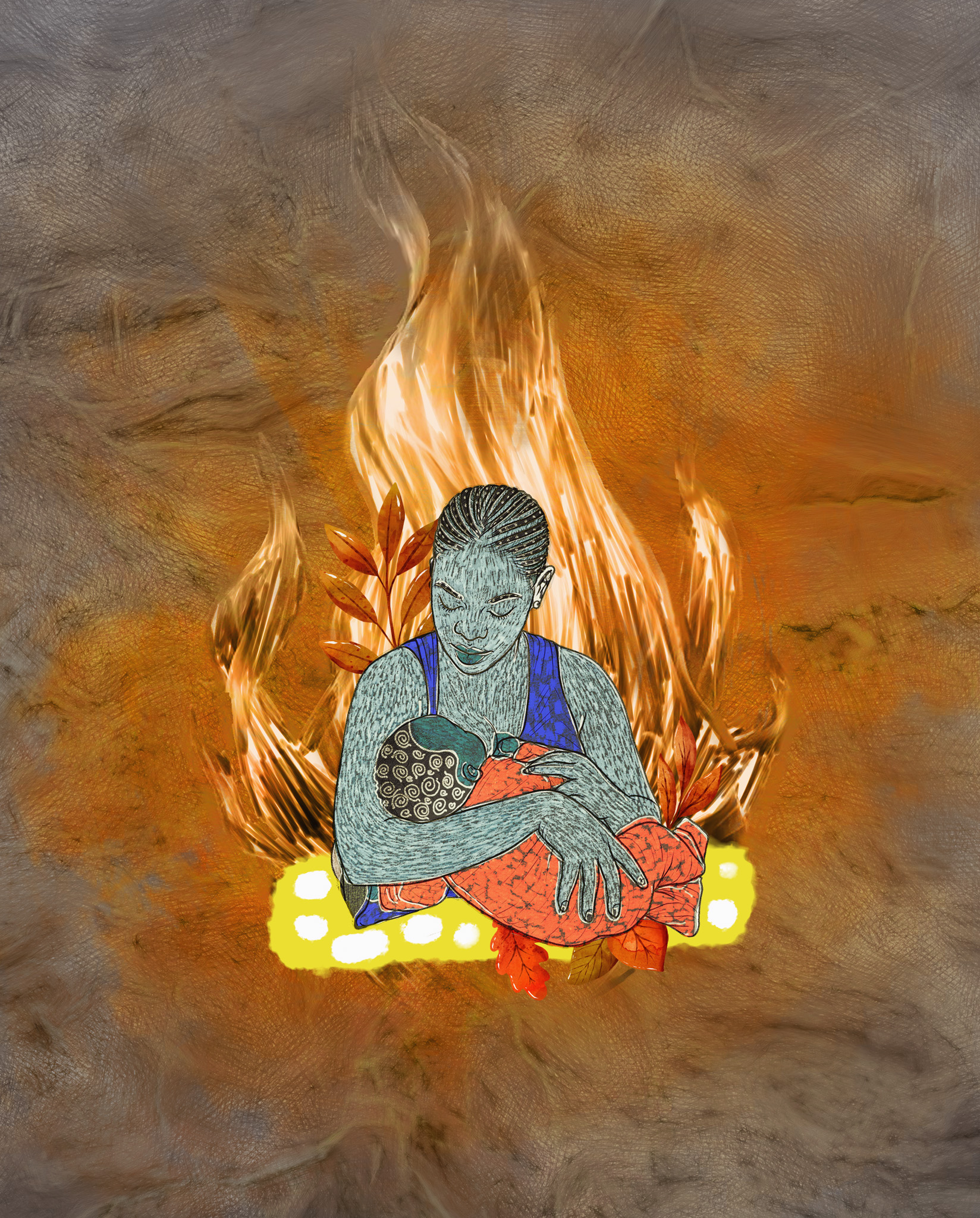
Invisible Inheritance
A story about how Mercy was trafficked, exploited, and abandoned.
A child's sense of self is built from safety, love, and belonging. But what happens when those are stripped away before they even take their first breath? For some, life begins in the shadow of danger, a mother undocumented, her pregnancy the result of manipulation or coercion. Even in the womb, stress leaves its fingerprints. Home becomes not a place, but a question mark. This is Mercy Njeru's story, a young Kenyan woman who left for what she thought was honest work, only to be trafficked, exploited, and abandoned in a foreign country. Amid that darkness, she became a mother. Today, she stands as a survivor advocate, but before she found her voice, she was fighting for her life and her child's right to exist.
***
"I was nineteen when the idea of working abroad began to feel less like a choice and more like the only option. A friend in Saudi Arabia told me she could connect me with an agent who would find me work in Qatar."
The process required Mercy to travel to Nairobi to get her passport. The agent who was assisting her managed to secure it within three weeks. By September, she was on her way to Qatar. She had been promised a job as a cleaner at the airport. However, when she arrived, there was no one to receive her. She remained at the airport for two days, unable to contact anyone.
On the third day, she borrowed a phone from a stranger and called the agent in Kenya to explain her situation. Eventually, an older man came to pick her up. He drove her roughly 45 minutes away from the airport to an office, where she was told they were waiting for her employer to arrive. After another 48 hours of waiting, a different man came and told her she was being taken to work in his house instead.
Confused, she protested. They had promised her a cleaning job, not to be someone's live-in housemaid. Her chest tightened, and her stomach twisted as if the ground had slipped beneath her. She asked to see her contract. The one they pushed in front of her was in Arabic, the same one she had refused to sign back in Kenya until they provided her with an English version. That English contract hadn't said anything about domestic work.
"I want to go back to Kenya," She told them, thinking this could be fixed. But they laughed. She could leave, they said, if she paid them $3,000, the cost of bringing her to Qatar. Three thousand dollars. She didn't even know what that looked like. It was more than her family would ever have in a lifetime. She knew her only option was to work until the debt was repaid. If she refused, they would throw her in jail.
Her calls to the agent went nowhere; her messages didn't go through. They said she owed them money. She was taken for medical tests and considered fit to work.
For two weeks, her employer locked her in a small room with three girls from the Philippines. The air was thick with the smell of sweat and disinfectant. When she asked where they worked, the other girls told her: in the man's house and in his parents' house as well.
At 3am Mercy was jolted awake. She was told she would now be working in another house in Lebanon. She protested, saying her contract was for Qatar only, but the man smirked, threatening he had "government connections" that could make her life miserable. Without options she quietly consented but she was screaming inside. She landed in Lebanon and spent the day at the airport before being driven three hours to a crowded three-bedroom home. The man's second wife explained her new role: caring for three children, a six-month-old, a one-year-old, and a three-year-old. The work began immediately. Her sleep was reduced to three hours a night, from 1am to 4am.
Illness came quickly, but instead of medical care, they gave her painkillers and sent her back to work. Promising payment tomorrow, which never came. She needed to send money back home.
By the sixth month, the detergents had eaten into her skin. Her hands were raw, blistered, bleeding. The doctor confirmed she was allergic, but she was forced to continue using the same corrosive products. Eventually, she collapsed. They locked her in a room and stopped feeding her. A replacement arrived the following day.
One afternoon, the madam insisted that Mercy take the children to the mall. Mercy told her she was too weak, but the woman insisted. While the madam shopped, Mercy stayed with the kids. She spotted security guards and asked where she could find a police officer. Her hands trembled as she explained to the police about the hunger, the beatings, the little sleep. For a moment, she let herself believe she was safe.
Then the scanner blinked, the officer's eyes flicked to the screen, her stomach turned cold. They had summoned her employer, Mercy's breath caught.
The madam arrived, her fury pressed tight into the line of her mouth. The officers spoke only Arabic, their voices firm but unreadable. Mercy's throat closed; she had no words they could understand. She was just... standing there. Hope drained from her limbs. She was released back into the madam's care. That night, the locks clicked louder, keys slept beside pillows, and the walls closed in.
When, by chance, the front door was left unlocked one night, Mercy waited for the youngest child to sleep. Then she slipped out, no bag, no shoes, just the clothes she wore. The air outside was damp, smelling faintly of diesel. Every shadow made her glance over her shoulder. She flagged a red-plated taxi, and the driver, who spoke little English, drove her to a place where "some black girls stayed."
By morning, a young woman from Sierra Leone took her to a cleaning job and gave her food, clothes, and a bed for the night. The next day, she met Grace, a Kenyan woman who offered help but warned her that the only work available was hard to come by, and illegal.
That night, she found herself standing on the roadside, men slowed their cars and were very interested in knowing the new girl. Mercy's stomach turned. One man convinced her to leave with him. Inside, she asked to "get protection," then bolted, running until her lungs burned. She hid under a bridge for three days, her lips cracking from thirst, watching for any Black woman who might stop.
"I just need one person," She thought. "One person to see me."
Eventually, a man noticed her. She didn't speak to him. He began leaving food and water where she stayed. After a week, his quiet persistence wore her down. He said he could find her work as a housemaid. The place he took her to had two other women, one African, one Filipino, who told her he was "reliable," though part of her pay would always go to him.
After a month, the other women started disappearing. Mercy later learned they'd been pushed into sex work for higher pay. She called Grace, desperate, but Grace had nothing to offer. By the fourth month, Mercy was alone in the house with the agent.
"The others moved on," he said, hinting she could too if she wanted more money. But she couldn't, she was sending everything she earned home. Soon after the agent's advances began. First in words, then in hands she couldn't push away. She stopped fighting, because she didn't know what would happen if she kept saying no.
She didn't know it yet, but Jason was already there, clinging to her in silence. The heaviness in her bones that no amount of sleep could cure, the sudden waves of nausea that rose at the smell of food, the tears that came without reason and even the missed period; she blamed the symptoms on fear. Every locked room, every checkpoint of terror, she carried him unknowingly, his fragile heartbeat hidden beneath her own. When she finally forced herself to take a test, the truth came sharp and merciless. Jason. Life inside her when she had no freedom, no safety, no choice. The man vanished as if on cue, sending food only sometimes, a driver for hospital visits. The Wi-Fi was cut off. She couldn't reach home. And in that silence, the weight of carrying Jason became unbearable, because she carried him alone.
At her lowest, she tried to drink detergent, anything to end the pregnancy. She became so sick that the man moved back in, not out of care, but fear of trouble if she died. By five months, complications put her in the hospital for four more months. When Jason finally arrived by C-section, she breathed in the scent of him, warm, new, alive.
In that moment, joy and terror sat side by side. She knew she couldn't raise him there. "I have to take him home," She told herself. "Somehow."
Around that time, Kenyan women in Lebanon began protesting, fighting for repatriation. Mercy slipped into the crowd with the help of a Sierra Leonean woman. Around her were women with faces that mirrored her own story, some undocumented, some clutching children like life rafts. IOM Kenya promised shelter for homeless mothers and a way home. They told her to stay with the man until arrangements were set, to avoid a fight. But someone betrayed her, and he took Jason.
For a month, her arms ached with emptiness. She stopped breastfeeding, developed a painful infection, and knew it was deliberate. "They want my body to forget him," She thought, "But I never will."
A lawyer named Claire took her case, demanding proof that the man had any legal claim to Jason. He had none. Pressured, he threw her out. Later, tricked into returning for her clothes, she was locked in. It took Claire three days to bring the official papers that would free her, but Mercy would not leave without Jason. She was told, "You came here alone, you leave alone." In Lebanon, even an absent father's consent could chain a child in place. The man used her race and poverty as weapons, claiming she couldn't give Jason a good life.
When he disappeared, she begged his sister for help until she finally gave up his location. He ran again, but the police caught him. On the day of her flight home, she still needed his signature to release Jason into her care. Claire told her to go to the airport anyway, to wait. She stood with other freed women, her heart split between hope and dread, just as the plane was boarding, Claire returned with Jason in her arms.
***
"When his fingers curled around mine," Mercy said, "I realised I was holding on just as much as he was." She left Lebanon with only her child, the boy who had travelled with her through every moment of her terrible ordeal, hidden under her heartbeat.
Back in Kenya, she stayed with her sister, but the cost of diapers and formula broke her. After two months, she moved in with a friend and searched for work. Nairobi felt both familiar and foreign, the matatus still blaring, the streets still buzzing, yet everything seemed sharper, harsher under the weight she carried. Even the family house no longer felt like home.
Claire found her again, helping her open a small shop with KSh 50,000. Mercy sold household goods, later trained as a hairdresser, and eventually opened her own salon, paying Jason's school fees herself. Home, she realized, was no longer a place but a life she built with her son; fragile, imperfect, but hers.
***
"I didn't choose this fight, but I chose to keep going. I carry the voices of women still waiting for their children, still waking to empty arms. And to Jason: I tell our story so he'll know we never stayed silent. Silence is never consent. What I pass on to him is proof that dignity cannot be stolen, that love can cross any border. You are my proof the fight is worth it."





