

Leeds Beckett University - City Campus,
Woodhouse Lane,
LS1 3HE
Dr Olayinka Ajala
Reader
Dr Olayinka Ajala is an internationally recognised researcher working on exploring the dynamics of violent conflicts and climate change in West Africa and the Sahel. His areas of interests include insurgencies, terrorism, resource conflicts and internal displacement in the region.
 0000-0002-7999-3986
 Scopus ID: 57218853763

About
Dr Olayinka Ajala is an internationally recognised researcher working on exploring the dynamics of violent conflicts and climate change in West Africa and the Sahel. His areas of interests include insurgencies, terrorism, resource conflicts and internal displacement in the region.
Olayinka Ajala is a senior lecturer in Politics and International Relations at Leeds Beckett University and a Fellow of the Higher Education Academy. He previously worked for the Universities of York and Newcastle.
Olayinka holds a doctorate degree in Politics from the University of York and a Masters degree in Globalisation and Development from the Institute of Development Studies, University of Sussex.
In working with communities in the Niger Delta region of Nigeria, Olayinka has analysed how insurgencies are formed and how addressing human security issues could reduce violent conflicts. More recently, he has investigated counter-insurgency mechanisms such as drone warfare and the importance of interorganisational cooperation.
Olayinka consults for the Ministry of Defence, United Kingdom. He was previously a visiting fellow/lecturer at the Combating Terrorism Centre, United States Military Academy, West Point where he taught final year cadets. He has consulted for local and international organisations including the European Asylum Support Office (EASO), the Government of Belgium and was a lead panel analyst on 'Terrorism and Counter-Terrorism in Africa', a round table discussion at the John F Kennedy School of Government, Harvard University. He is also a regular analyst for media organisations such as the BBC and Aljazeera.
Olayinka is currently working on a GCRF funded project titled 'Catalyzing participation through innovation to strengthen rural-urban climate resilient futures in Namibia'. He is also a principal investigator on a CeASR funded project titled 'Sustainable agriculture in Nigeria: Understanding the link between conflict (and terrorism) and climate change in farmers' displacement and livelihood transformation'.
Olayinka teaches undergraduate and postgraduate modules at LBU and is interested in accepting PhD students in the areas of peace and security, terrorism and counter-terrorism, formation of insurgent groups, climate change and sustainable development especially in West Africa and the Sahel.
Related links
United Nations sustainable development goals
Research interests
Olayinka's research interests include rural development, resource conflict, human security, peace and security, terrorism and counter-terrorism, formation of insurgent groups, internal displacement, climate change and sustainable development.
Ask Me About
Publications (28)
Sort By:
Featured First:
Search:
Niger: Recent History
 14 November 2024
Africa South of the Sahara 2025 Routledge
14 November 2024
Africa South of the Sahara 2025 Routledge
The definitive one-volume guide to all sub-Saharan African countries, providing invaluable economic, political, statistical and directory data.
Africa South of the Sahara 2026: Niger, recent history
13 November 2025
Africa South of the Sahara 2026 Routledge
The definitive one-volume guide to all sub-Saharan African countries, providing invaluable economic, political, statistical and directory data.
01 March 2023
Regional Environmental Change23(1):1-20 Springer Science and Business Media LLC
 Thorn JPR, Nangolo P, Biancardi RA, Shackleton S, Marchant RA, Ajala O, Delgado G, Mfune JKE, Cinderby S, Hejnowicz AP
The scale of climate migration across the Global South is expected to increase during this century. By 2050, millions of Africans are likely to consider, or be pushed into, migration because of climate hazards contributing to agricultural disruption, water and food scarcity, desertification, flooding, drought, coastal erosion, and heat waves. However, the migration-climate nexus is complex, as is the question of whether migration can be considered a climate change adaptation strategy across both the rural and urban space. Combining data from household surveys, key informant interviews, and secondary sources related to regional disaster, demographic, resource, and economic trends between 1990 and 2020 from north central and central dryland Namibia, we investigate (i) human migration flows and the influence of climate hazards on these flows and (ii) the benefits and dis-benefits of migration in supporting climate change adaptation, from the perspective of migrants (personal factors and intervening obstacles), areas of origin, and areas of destination. Our analysis suggests an increase in climate-related push factors that could be driving rural out-migration from the north central region to peri-urban settlements in the central region of the country. While push factors play a role in rural-urban migration, there are also several pull factors (many of which have been long-term drivers of urban migration) such as perceived higher wages, diversity of livelihoods, water, health and energy provisioning, remittances, better education opportunities, and the exchange of non-marketed products. Migration to peri-urban settlements can reduce some risks (e.g. loss of crops and income due to climate extremes) but amplify others (e.g. heat stress and insecure land tenure). Adaptation at both ends of the rural–urban continuum is supported by deeply embedded linkages in a model of circular rural–urban-rural migration and interdependencies. Results empirically inform current and future policy debates around climate mobilities in Namibia, with wider implications across Africa.
US drone base in Agadez : A security threat to Niger?
2018
RUSI Journal163(5):20-27 Taylor & Francis (Routledge)
The Sahel Sahara is one of the largest poorly governed regions in the world. Terrorism, banditry, trafficking (humans, arms, drugs), cattle rustling and armed robbery have thrived in the region. The governments of the countries that share the region’s borders appear unwilling or unable to govern their territories. In 2014, the US government, in agreement with Niger, decided to build a $110-million drone base in Agadez. In this article, Olayinka Ajala explores the potential impact of the base on the already fragile security of the Sahel Sahara and sub-Saharan Africa. © RUSI.
Why Nigeria’s election was an improvement on previous polls
What to expect as 84 million Nigerians go to the polls
Buhari hasn’t solved Nigeria’s security threats. Will voters punish him?
Nigeria is not ready to hold free and fair elections next year. Here’s why
Why clashes are on the rise between farmers and herdsmen in the Sahel
COVID-19 Pandemic: A Wake-Up Call for African Leaders
Human security in the Niger Delta: exploring the interplay of resource governance, community structure and conflicts
29 November 2016
Journal of Sustainable Development Law and Policy (The)7(2):81 African Journals Online (AJOL)
Prior to August 2009, the Niger Delta region of Nigeria witnessed widespread violent conflicts between the government, multinational oil corporations (MNCs) and militant groups. This conflict was widely attributed to deplorable human security, which deprived the indigenes of the region access to their sources of livelihoods due to pollution, by MNCs. In 2009, the government granted amnesty to thousands of ‘repentant militants’ and this programme has achieved mixed results. This article will explore the impact of human security on the outbreak of violence in the Niger Delta and the impact of the Amnesty Programme in addressing issues relating to human security. The article concludes that bottom-up community-driven initiatives offer the best approach to address human security issues in the Niger Delta. The article is based on an ethnographic research carried out in 2013 in three states in the region (Bayelsa, Delta and Rivers states). Keywords: Human security, justice, environment, Niger Delta, MNCs
Formation of Insurgent Groups: MEND and Boko Haram in Nigeria
2018
Small Wars and Insurgencies29(1):112-130 Taylor & Francis (Routledge)
Contrary to earlier notions that religious diversity, ethnicity and the lack of economic development are the main factors responsible for the surge of violence in Nigeria, this article argues that the means of attaining or retaining political authority by politicians are responsible for violent conflicts and the formation of insurgent groups. Using theories of patrimonialism and prebendalism, the article argues that political power and authority are often channelled for personal use in a predatory manner that results in the formation of insurgent groups. The aim of this article is to proffer a different analytical framework for the understanding of the formation of insurgent groups based on political authority. © 2017 Informa UK Limited, trading as Taylor & Francis Group.
Nigeria’s 2019 election: a two-horse race with uninspiring candidates
The New Scramble for Africa
05 March 2025
Africa, the EU and the Samoa Agreement Routledge
One of the key events which happened during the negotiations of the Samoa Agreement was the truncation of democracy in some countries in Sub-Saharan Africa (SSA). Sudan, Mali, Chad, Guinea, Burkina Faso and Niger all experienced military takeover in the last five years. While issues such as insecurity, corruption and economic vagaries were depicted as responsible for military takeover by the putschists, the role of external actors such as Russia and China have also been highlighted. Although there is no substantive evidence of these countries’ involvement in the coups, both countries have been involved in the new scramble for Africa. For instance, key countries in the Sahel such as Niger, Burkina Faso and Mali have severed relationship with France while embracing Russia. This chapter argues that the implementation of the Samoa Agreement could be impacted by these waves of democratic deficits and the increased efforts of Russia to establish deeper partnerships with the military leaders. Drawing on examples such as recent military ties between Niger and Russia and the implication on the proposed gas pipeline from Nigeria to Europe, this chapter will explore how the democratic fragility in SSA could impact on the effective implementation of the Samoa Agreement.
The four key factors that determined the outcome of the Nigeria poll
Buhari’s visit to South Africa eased tensions. But more needs to be done
Nigeria: why having fewer political parties isn’t enough
Nigerian Elections 2019: Entrenching Democracy?
31 May 2018
E-International Relations1-4 E-International Relations
Evolution of Agricultural Policies and Laws in Nigeria.
05 January 2015
Food and Agricultural Law: Readings on Sustainable Agriculture and Law in Nigeria Afe Babalola University
Authors: Ajala O, Editors: Rhuks A, Damilola O 09 September 2020
Third World Quarterly41(12):1-19 Informa UK Limited
In the last few years, several African countries have witnessed an increase in conflict between pastoralists and sedentary farmers and among pastoralist groups. While issues such as climate change, desertification, regional conflicts, population expansion, trafficking and terrorism have been highlighted as the reasons for the surge in violence, none of these issues fully explain the increased use of small and light weapons by several pastoralist groups and sedentary farmers. This article explores the changes in the dynamics of cattle ownership, termed neo-pastoralism, as a possible explanation for the increase in armed clashes between the groups. The article explains how traditional pastoralism is gradually giving way to neo-pastoralism, a form of pastoralism which involves larger herds and increased use of arms and ammunitions. Nigeria is used as a case study to explore these new patterns of conflict due to having the largest number of cattle in the sub-Saharan Africa region and the scale of the conflict in the country. This article is based on field research and interviews carried out in Nigeria between 2013 and 2019.
Evolution and decline: transformation of social movements in Nigeria
03 April 2022
Review of African Political Economy49(172):246-263 Informa UK Limited
Despite the rising academic scholarship on democracy, particularly the role played by social movements in entrenching democracy in Africa, few studies have explored the transformation of social movements after they have achieved (or come close to achieving) their stated goals. Using a case study of the Oodua Peoples Congress in Nigeria, this study argues that social movements in Africa lack the capacity to transform and often become partisan or disintegrate. The study concludes that the unique characteristics of African politics, coupled with the inability of social movements to maintain public support after initial gains, eventually weaken the movements.
25 January 2021
American Journal of Economics11(1):10-18
Ajala O, Laniran TThe impact of military expenditure on economic growth has continued to be a subject of debate in the literature. In several African countries, military expenditure has been on the increase in the last few decades making it imperative to explore the impact of military expenditure on the growth of the economy. This study investigates the relationship between military expenditure and economic growth in Nigeria using annual time series data from 1981 – 2017. In achieving this objective, the study adopted a simple growth model that incorporates military expenditure as a share of government expenditure for the period of study. The autoregressive distributed lag (ARDL) estimation technique was used in testing the relationship between the variables in the model. The result of the study shows that there is a significant positive long-run relationship between military expenditure and economic growth.
07 May 2021
Information & Security: An International Journal48:97-114 Procon, Ltd.
The transnational nature of security threats in the 21st Century are such that interorganizational cooperation is necessary to effectively combat these threats. This article explores a key organization, the Multinational Joint Task Force (MNJTF), charged with curtailing the threat posed by terrorism in certain parts of the Sahel and West Africa. Using the theoretical framework of Walt’s balance of threat and a combination of data obtained from ACLED and expert interviews, the article argues that the MNJTF has not been successful in achieving its mandate. This could be attributed to five lapses in the restructuring of the organization in 2015 to combat terrorism. The article concludes that for interorganizational security cooperation to be successful, the allies must equally acknowledge that they face the same existential threats which will make them commit to the demands of the organisation.
Russia’s war with Ukraine: Five reasons why many African countries choose to be ‘neutral’
The Case for Neutrality: Understanding African Stanceson the Russia-Ukraine Conflict
15 July 2023
International Organisations Research Journal18(2):7-30 National Research University, Higher School of Economics (HSE)
The war in Ukraine is impacting most countries in the world. Economically, prices of goods and services are rising and manycountries around the world are experiencing energy crises that can be linked to the war in Ukraine. Politically, fracturesare appearing in long-established political structures with many countries around the world deciding on how to respondto the war in Ukraine based on their political, economic, and strategic interests. Surprisingly, Africa is generating a lot ofattention due to the stance of several notable countries – including some seen as key allies of Western countries. Contraryto expectations that most African countries except those ruled by despots would follow the West in condemning and puttingpressure on Putin to end the war, many African countries chose to stay neutral without condemning Russia or supportingresolutions to put pressure on Putin to end the war. This article has explored not only the role of neo-imperialism in shiftingpolitical alliances away from the West as well as a key factor fostering neutrality, but also other factors. It has made use ofUN resolution voting patterns as well as statements made by African leaders as lenses through which the stances of Africanleaders can be understood. The article “The Case for Neutrality: Understanding African Stances on the Russia-Ukraine Conflict” by Olayinka Ajala is translated and published with permission of the author and и Journal of Military and Strategic Studies, where it was originally published in English (Journal of Military and Strategic Studies (2022), vol. 22, iss. 2). Available at: https://www.mapleleafnavy.com/index.php/2023/02/16/journal-of-military-andstrategic-studies-volume-22-issue-2/.
29 January 2025
African Security18(1):1-28 Informa UK Limited
Ajala O, Murphy JVigilantism is not a new phenomenon in Nigeria. As a state with various “alternatively governed” spaces the country has leant on vigilantes of differing forms as a source of authority where the state has been ineffective. Albeit proving controversial, their successes cannot be unrecognized. This article explores the public’s perception on vigilantes and the extent to which they should be deployed in Nigeria. We argue that vigilantes can have a role within counterterrorism initiatives especially in alternatively governed spaces. Vigilantes have a positive perception in Nigeria and with more training and structuring, vigilantes can be more effective in counterterrorism.
Current teaching
- Rethinking diplomacy
- International human rights
- Theorising human rights
- International peacekeeping
Grants (1)
Sort By:
Featured First:
Search:
International Writing Workshops 2022 Programme
News & Blog Posts
Special Assistant to the President of Nigeria visits Leeds Beckett to discuss climate change, peace and security in Africa

Leeds Beckett event to discuss climate change, peace and security in Africa

Why climate change is causing conflict in Africa

Recount of Democratic Transition in Niger

US air strikes in northern Nigeria: possible windfalls, as well as dangers
Is there a Christian genocide in Nigeria? Evidence shows all faiths are under attack by terrorists
Terrorisme au Sahel : pourquoi les attaques contre les bases militaires se multiplient et comment y répondre
West Africa terror: why attacks on military bases are rising – and four ways to respond
Lutte anti-terrorisme en Afrique de l'Ouest : une collaboration étrangère et régionale est nécessaire
Terrorism is spreading in west Africa – local and international collaboration is needed to fight the threat
Russie-Ukraine : les risques d'une extension du conflit à l'Afrique de l'Ouest
Russian flags waved during Nigeria protests: why it’s a cause for concern
Russia-Ukraine war spills into west Africa: Mali attacks signal dangerous times ahead
L'armée américaine laisse le Niger encore moins sûr : pourquoi elle n'a pas réussi à lutter contre le terrorisme
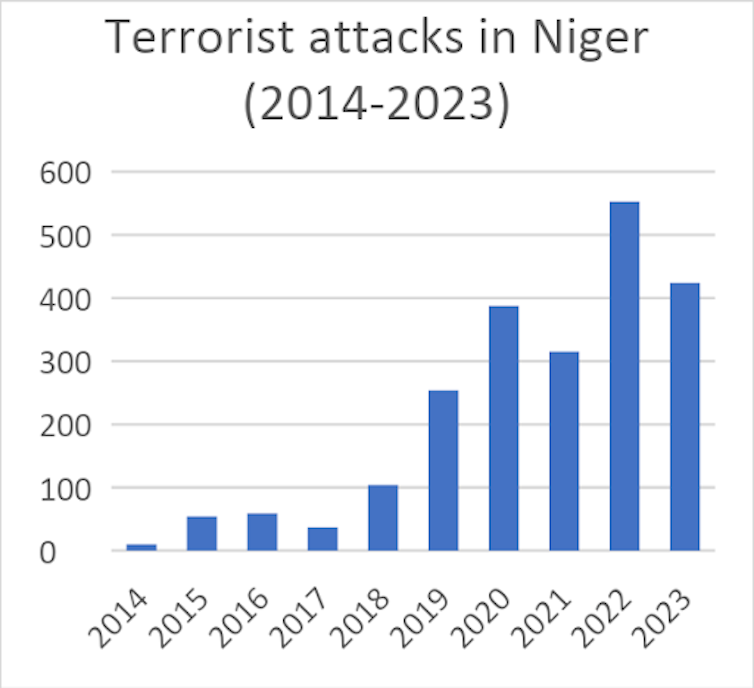
US military is leaving Niger even less secure: why it didn’t succeed in combating terrorism
Sommet de la Cedeao : 6 mesures que les dirigeants peuvent prendre pour rétablir la stabilité et la croissance en Afrique de l'Ouest
Ecowas: 6 steps the leaders can take to restore stability and growth in west Africa
Le Niger et la Russie nouent des liens militaires : trois façons de contrarier les anciens alliés
Le Niger rompt sa coopération militaire avec les États-Unis : pourquoi c'est mauvais pour la sécurité du Sahel
Niger has cut military ties with the US: why this is bad for the Sahel’s security
Ecowas: west African trade bloc shaken as three member states withdraw and form their own alliance





