Leeds Beckett University - City Campus,
Woodhouse Lane,
LS1 3HE

It's a young boys' game: The ICOACHKIDS+ 'Sport Participation Trends' report is out
The first of its kind, this unique study led by Leeds Beckett University collected data about 5.5 million young people from across 29 European countries and 18 different sports. Findings show how girls are four times less likely than boys to engage in organized sport, and that participation peaks at 14 years of age.

Children’s physical activity levels and competence have declined steadily and globally over the last two decades. The impact of this decline in their physical and mental wellbeing has been show in multiple studies. This has become even more important during the COVID-19 pandemic where physical activity levels reduced across the board.
This study is part of the Erasmus+ co-funded project ICOAHCKIDS+ which aims to enhance sport participation, reduce dropout, and maximise the health enhancing properties of sport. The research team was led by Dr Stacey Emmonds and included Dr Sergio Lara-Bercial, Prof Kevin Till and Dr Dan Weaving of the Carnegie School of Sport. It is the first time that a multi-country and multi-sport study of this kind has been conducted to investigate participation rates in organized youth sport.
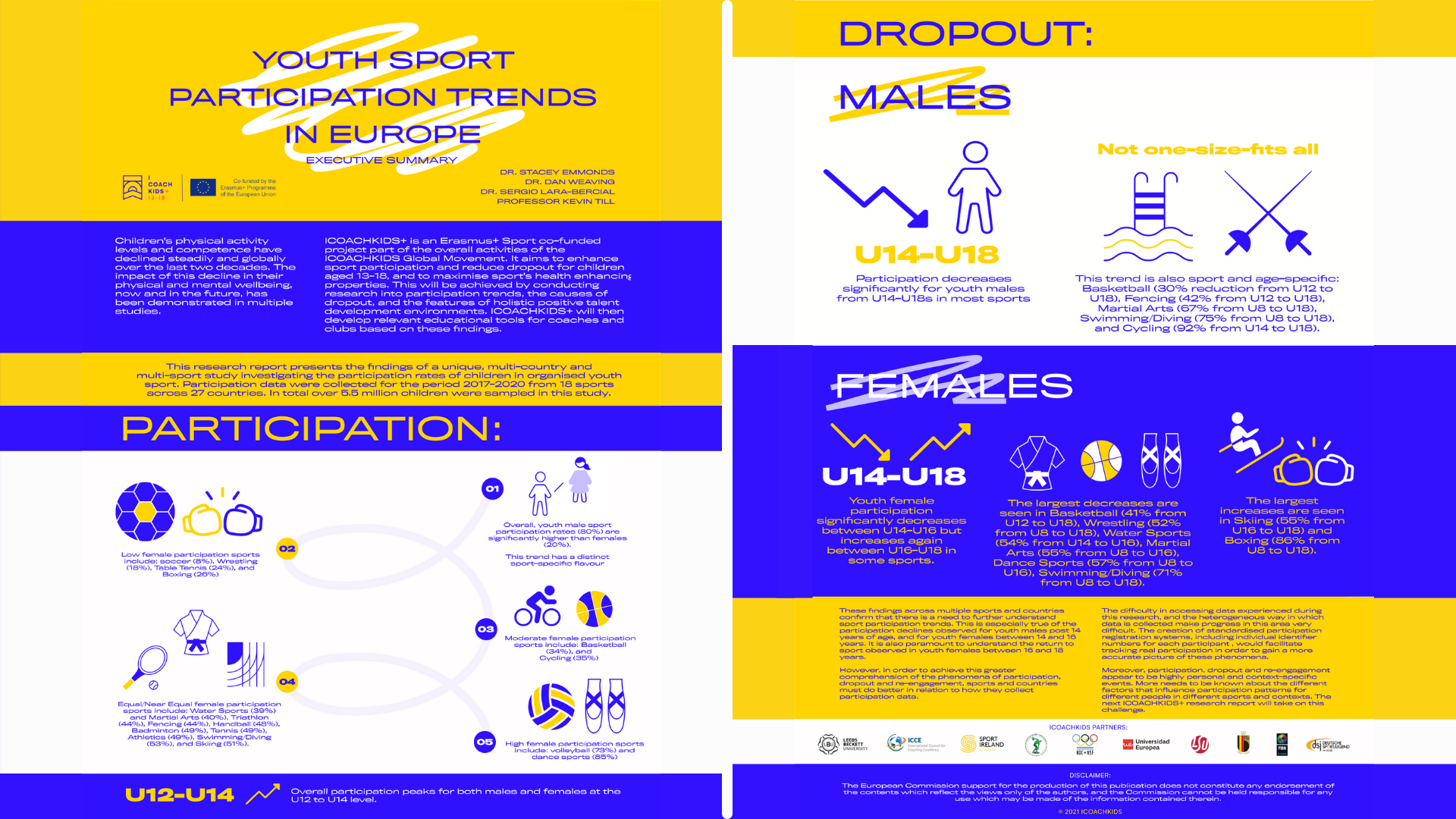
Participation data were collected for the period 2017-2020 from 18 sports across 29 countries. In total over 5.5 million children and young people were sampled in this study. The analysis of the data shows some key findings:
- Overall, youth male sport participation rates (80%) are significantly higher than females (20%).
- This trend, however, has a distinct sport-specific flavour. Some sports like football (8%) and wrestling (18%) have very low female participation, whereas others such as volleyball (73%) and dance sports (85%) are primarily played by girls.
- Overall participation peaks for both males and females between 12 and 14 years of age.
- Participation decreases significantly for boys from 14 to 18 years of age in most sports.
- Girls participation significantly decreases between 14 and 16 but increases again between 16 and 18 in some sports.
These findings confirm that there is a need to further understand sport participation trends. Sport attrition is not a one-size-fits-all affair. To get this fine-grain detail, sports and countries must improve their data collection processes. The difficulty in accessing data experienced during this research, and the heterogenous way in which data is collected make progress in this area very difficult. The creation of standardised participant registration systems would facilitate getting a more accurate picture.
Moreover, participation, dropout and re-engagement appear to be highly personal and context-specific. More needs to be known about the different factors that influence participation patterns for different people in different sports and contexts. The next ICOACHKIDS+ research report will take on this challenge.
The executive summary of the report can be downloaded here. You can access the full report here.
Details on the ICOACHKIDS website.

Dr Stacey Emmonds
Stacey is a Reader in Sports Performance with an established international reputation for research excellence in applied sport science. She has published over 75 peer-reviewed research articles, with a primary focus on sports performance and football, contributing significant advances to both academic knowledge and applied practice. Stacey leads key research and knowledge exchange partnerships across the professional football landscape, working nationally with Premier League clubs and the Women’s Super League (WSL). She also leads high-impact research and consultancy projects in collaboration with The Football Association (The FA), UEFA, and FIFPRO, translating evidence-based research into practice to inform performance, policy, and development within elite football. Stacey is regularly invited as a keynote speaker at national and international conferences and knowledge exchange events, where she shares evidence-based insights with academic, professional, and governing body audiences, supporting the translation of research into applied performance practice.
She is currently working with England women’s youth national teams and has supported teams across multiple UEFA European Championships, as well as the FIFA U17 Women’s World Cup. In addition, Stacey holds an advisory role at UEFA as a member of the UEFA Fitness for Football Advisory Group, contributing expert insight to the development of performance standards and practice at the international level.

Professor Kevin Till
Kevin Till is Professor of Athletic Development within the Carnegie School of Sport. He leads applied research, knowledge exchange and doctoral-level teaching activities across coaching and sport science focussed on youth populations and making a difference to policy and practice.

Professor Sergio Lara-Bercial
Sergio is a Professor of Sport Coaching. A former Team GB coach Sergio has extensive international experience in the development and evaluation and coach education systems. He has also conducted research into High Performance Coaching and Positive Youth Development. Sergio is the director of the globally acclaimed iCoachKids project.

Dr Dan Weaving
Dan Weaving is a former Senior Lecturer at Leeds Beckett.