Leeds Beckett University - City Campus,
Woodhouse Lane,
LS1 3HE
Stories
LBU Research Voices - Bringing academic insight to an innovative company to repurpose NHS healthcare waste in the civil engineering industry
Welcome to LBU Research Voices, a blog series that celebrates the experiences, journeys, and expertise of our LBU research community. Through this series, we'll explore the knowledge our researchers have gained - not just from their work, but from their lived experiences, career paths, and the communities they engage with. By sharing their stories, we hope to inspire learning, reflection, and connection across our LBU research culture.
In our new post, we met up with Dr Ash Ahmed, Reader in Civil Engineering Materials Science, to find out all about his first experience of leading a Knowledge Transfer Partnership (KTP). Ash leads our KTP with NuGreen, which is developing and commercialising innovative new low-carbon products for the civil engineering industry, using NHS healthcare waste.

Stories

This is your first KTP project - what made you want to get involved, and how did you go about developing the project and building the partnership with NuGreen?
I have been working in the materials science area for over 20 years and my research has exclusively focussed on the development of low carbon materials or materials containing recycled/waste products, primarily for civil engineering and construction applications.
In the current climate this is especially pertinent given the construction materials industry is responsible for emitting up to 10% of global CO2 emissions... to put this into perspective the much maligned commercial aviation sector emits 'only' 3% in comparison!
Given one of the main objectives of a KTP project is the new product commercialisation, there is great commercial potential, thus for a while I have been looking for the ideal opportunity for a sustainable low carbon material development.
By creating awareness through dissemination of the previous work and research done by the Leeds Beckett University Sustainable Materials Group, NuGreen contacted me as they were looking for an application / pathway for the waste PPE generated by hospitals and medical practices, etc.
Following a promising feasibility pilot study which highlighted the potential to repurpose the waste in civil engineering materials, this led to the successful KTP application! A strong academic team was quickly assembled involving Dr Alfred China (Leeds Business School) for his business acumen, and Dr Killian Ngong and Dr Sepehr Ghafari for their expertise in Highways Engineering. It must be emphasised the successful application would not have been possible without the immense contribution and assistance from Anne-Marie Gallagher and Jo Griffiths (KTP office), without their guidance we wouldn't be here today discussing the project!

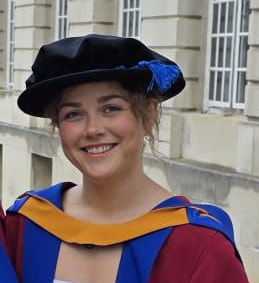
NuGreen KTP Associate, Habiba El-Gharably
What was your experience of the application process and recruitment of the KTP Associate who manages the day-to-day running of the project?
The application process entailed an intensive two stage process. Given the multidisciplinary nature of the project encompassing the materials science and civil engineering fields, the advertisement aroused substantial interest. Due to the hybrid nature of a KTP involving an industrial partner and academics (from both a scientific and business background), there was an extensive panel ensuring all areas of expertise were covered.
Given the rapport developed between the colleagues from LBU and NuGreen, everyone was singing from the same hymn sheet and remarkably (but unsurprisingly) there was total acquiescence during shortlisting. For the second interview both the NuGreen and LBU colleagues agreed the final candidates would prepare a presentation looking at both perspectives to showcase their scientific competence and commercial attributes.
Ultimately, the panel unanimously agreed on the successful candidate, Habiba El-Gharably who has thus far excelled in the role with aspirations to pursue a doctorate degree which is one of many opportunities a KTP associate role presents.

How do you plan to use the project’s findings in your future research or teaching?
An integral part of my role as a reader is to ensure my modules are, wherever possible, underpinned by research findings and potential. For example, my MSc module (Materials Technology) is entirely based around my research interests in the field of sustainable materials utilized in construction and civil engineering applications.
Given one of the prime aims and objectives of the module is looking at established, current and future trends of sustainable materials, this presents the ideal opportunity for the initial findings and a lab practical session using the medical waste to be incorporated into one of the sessions for the upcoming semester 1 delivery. As the project yields further findings, this will be disseminated accordingly at both Masters and also undergraduate modules, especially given the vast number of students/apprentices on our courses from industry which will further facilitate in creating awareness.

Dr Ash Ahmed and Habiba El-Gharably - Habiba is holding the waste medical material (floc, in her right hand) which they are repurposing as a low carbon aggregate in civil engineering materials - in her left hand she is holding asphalt concrete for roads and highways, and Ash is holding concrete, which both contain waste floc.
Can you tell us about the key goals of your KTP with NuGreen, and how the project is helping transform healthcare waste processing to be more sustainable?
In the UK nearly 160,000 tonnes of clinical (PPE) waste is generated annually - we all remember how prevalent PPE was during the recent covid pandemic! Most of the waste ends up being incinerated. This is clearly not very sustainable due to the high embodied CO2. Furthermore, given that sand (a key ingredient in construction materials) is being rapidly depleted, it is imperative to conserve the availability of this material for future generations. This may sound surprising given the copious amount of sand on beaches, deserts, etc however, it must be borne in mind only a specific and selective type of sand can be utilised in civil engineering materials.
Therefore, the key goal of the KTP with NuGreen is to divert healthcare waste away from incineration and instead repurpose it as a low-carbon aggregate in concrete - a partial aggregate replacement. By doing so, the project not only tackles the environmental impact of waste incineration but also creates a sustainable alternative material for the construction sector, thus potentially reducing the aggregate demand.
The primary ambition is to reach the stage where several of these products can be commercialised, helping to reduce carbon footprints in both healthcare and construction while supporting a more circular economy.

What have been some of the milestone achievements of the KTP so far?
About eight months into the project, the KTP has reached some exciting milestones towards our goal of utilising treated healthcare waste as an aggregate alternative in concrete. The lab work for the first batch of concrete samples containing the waste floc has now been completed. This stage was both exciting and rewarding, as it marked the point where all the practical effort in the lab had started to come together into clear outcomes.
Following careful scrutinisation of initial findings, the analysis not only confirmed some of our expectations, but also revealed new insights that will help shape the next stages of the work. Further research is imperative, however, primary findings show a wide range of structural applications for the waste floc as a low carbon aggregate. It must be emphasised the whole KTP team are very grateful for the assistance by the Materials Lab learning officers, Kev Smith, Kamal Elnaseih and Dan Taylor.
To maximise awareness, dissemination is absolutely crucial, and at the time of writing this, the initial journal paper is being compiled; this paper brings together key findings, analysis, and insights. Over the coming months, work will continue on the remaining batches, further data analysis, and integrate new findings into the final outputs of the work plan. We are looking forward to seeing how these next steps add even more depth to the work already achieved.

How do you and the wider team - including Habiba and colleagues at NuGreen - work together to keep the project on track?
Keeping the project on track is very much a team effort. The associate, Habiba, works closely with NuGreen colleagues and academic experts at Leeds Beckett University through regular check-ins including catch ups with the KTP office (Rosi Newman), where progress is reviewed and next steps are agreed together.
Understandably, with numerous colleagues involved, Habiba commendably and efficiently communicates with all members and pro-actively organises monthly progress meetings (both online and face-to-face) whereby she updates the team on progress. Habiba's role often involves connecting different strands of the project, ensuring that insights are shared through regular meetings and that any challenges are addressed quickly. She stresses that open communication and mutual respect are central to the collaboration, with each member of the team bringing valuable expertise to help drive the project forward.
Furthermore, with numerous forms of communication, I have emphasised to Habiba I am always available (when not lecturing!).

The LBU and NuGreen KTP team
What long-lasting impact do you hope the KTP will have?
It is hoped the KTP will have a lasting impact by proving that healthcare waste can be redirected from incineration and instead used as a low-carbon aggregate in construction. A key part of this vision is the supply chain mapping which Habiba is working on with Dr Chinta, which will make it easier for healthcare providers and construction partners to understand how waste can move seamlessly from hospitals to new, sustainable applications.
Ultimately, completion of the lab work as stipulated in the workplace will substantiate the proof of concept as the medical waste floc is indeed a viable sustainable constituent (with a seemingly inexhaustible supply) in the major civil engineering/construction materials for a wide range of applications.
By laying this groundwork, we hope the project will not only deliver new commercial products but also establish a clear pathway for wider adoption. Ultimately, the KTP is a catalyst for long-term change; reducing carbon emissions, supporting a circular economy, and encouraging collaboration across sectors to tackle environmental challenges.

Dr Ash Ahmed
Leading several undergraduate and postgraduate modules in the field of civil engineering materials science to primarily civil engineering students and also to construction, surveyors and architects.