
Leeds Beckett University - City Campus,
Woodhouse Lane,
LS1 3HE
Stories
LBU Research Voices - Amplifying Muslim Women's Voices in Sports Spectatorship
Welcome to LBU Research Voices, a blog series that celebrates the experiences, journeys, and expertise of our LBU research community. Through this series, we'll explore the knowledge our researchers have gained - not just from their work, but from their lived experiences, career paths, and the communities they engage with. By sharing their stories, we hope to inspire learning, reflection, and connection across our LBU research culture.
In our latest post, we met up with Fatin Nabilah Azren, a PhD student and MSc graduate in the Carnegie School of Sport, who is researching Muslim women's experiences as sports spectators in Malaysia. Fatin shares her reflections on studying in the UK as an international Muslim woman, the importance of helping people from underrepresented cultures, faiths and countries to feel included in academia, and her ambitions for her research to increase inclusion, belonging and representation in global sports.
Stories

Can you tell us what your PhD research focuses on, and what reflections have you taken so far from your conversations with Malaysian Muslim women?
My PhD explores Muslim women's experiences as sports spectators in Malaysia, focusing on how they navigate spaces shaped by Islamic practices in sporting cultures. Malaysia offers a unique context for this research because it blends religious values with modern sporting lifestyles. It's a place where you can see women expressing their enthusiasm for sports while also being guided by their faith, and sometimes, that balance isn't easy.
Through my interviews with Malaysian Muslim women, I've been deeply inspired by how they describe their experiences. Many of them love the excitement of attending matches and feeling part of the atmosphere, yet they often have to make careful choices about where to sit, what to wear, or how to manage prayer times during long events.
What stands out to me is their resilience and adaptability. They're not rejecting sport, nor compromising their beliefs; they're finding ways to make both coexist meaningfully. Their stories reflect a powerful harmony between religious devotion and leisure participation, and they show that sport can indeed be a space for inclusion when it respects and recognises faith.

Fatin with her prize at the Carnegie School of Sport annual PGR Conference 2025
Do you find that your own experiences attending sporting events have influenced how you approach your research, or shaped the way you connect with your participants’ stories?
Definitely. Growing up in Malaysia, I've experienced first-hand what it's like to live at the intersection of Islamic values and global sporting culture. I've always enjoyed the energy and unity that sports bring. Still, as a Muslim woman, there have been times when I questioned whether I truly belonged in certain spaces, whether my presence, my attire, or even my excitement might be judged.
Some of my participants shared that they only attend matches if accompanied by their husbands or siblings, or when the environment feels safe and family oriented. Others, especially younger or unmarried women, described how they still love watching sports but often choose to follow games digitally or through broadcasts rather than attending live events, not because they lack interest, but because they want to remain aligned with Islamic practices in sporting cultures.
Because of that, I understand deeply when my participants talk about seeking their families' approval before attending a match or preferring to go only when accompanied by someone close. These aren't barriers; they are expressions of faith. They show how Muslim women in Malaysia negotiate their love for sports while staying grounded in Islamic values and cultural expectations. This shared understanding allows me to listen with empathy and respect, knowing that their voices reflect not only individual experiences but also the collective rhythm of faith that guides our actions.

Fatin and the volunteering team at the WiSEAN (Women in Sport and Exercise Academic Network) Conference 2025 at LBU
Reflecting on your research so far, what do you think sporting event organisers could do to create more inclusive environments?
I believe that true inclusivity means recognising and respecting Islamic practices in sporting cultures, especially in contexts like Malaysia, where Muslim women make up a large and passionate audience. To make sporting events more welcoming, organisers could start with simple but impactful improvements that align with Halal tourism principles.
For example, providing clean and accessible prayer facilities within or near stadiums would make it easier for spectators to perform their religious obligations without feeling excluded or rushed. Similarly, introducing designated women's seating areas or family zones, and even separate entrances for women and families, could create a more comfortable and respectful environment. These are not restrictive measures; they are ways to ensure that every woman feels safe, valued, and able to enjoy the event fully while observing her faith.
Organisers should also prioritise Halal-certified food options and clear information about available facilities. Staff training on cultural and religious sensitivity can further enhance the spectator experience, ensuring that inclusion isn't just about physical space, but also about attitude and respect. Beyond the organisers, I believe Malaysia's government and sports authorities have a real opportunity to champion this approach by promoting Halal Tourism in sporting events as part of the country's identity. Malaysia is already known as a leading destination for Halal travel and hospitality; extending that concept into the sports sector could position the nation as a global model for inclusive, faith-sensitive sports tourism.
By doing so, Malaysia wouldn't only create more welcoming environments for Muslim women but also showcase how faith and modern sporting culture can coexist harmoniously, sending a powerful message to the world that inclusivity can be both culturally authentic and globally inspiring.
How has your experience of studying at LBU compared with your previous industry or research experiences, particularly in relation to feeling included and represented?
Studying at Leeds Beckett University has been an empowering and reflective journey. As an international Muslim woman, I was initially unsure about how my topic, which focuses on faith and gender in sports, would be received. But from the beginning, my supervisors and colleagues have been incredibly supportive. They encouraged me to embrace my cultural background and integrate my lived experiences into my academic focus.
This encouragement has helped me see that my perspective, shaped by Islamic practices in sporting cultures and the realities of Malaysian society, is not a limitation, but a strength. It brings new ways of understanding inclusion, belonging, and representation within global sports contexts.
Studying at LBU has shown me what a genuinely supportive academic environment looks like. It has allowed me to find my voice as both a researcher and a Muslim woman who wants to make positive change through my focus.

Fatin at her Masters graduation at LBU in 2023
Have there been any mentors or role models, either in events and tourism or in research, who have helped you navigate challenges of underrepresentation?
Yes, I've been truly fortunate to have incredible mentors. My supervisors, Dr Davide Sterchele, Dr Chen Zheng, and Dr Ellie May, have played such an important role in guiding me, both academically and personally. They've never made me feel like my focus on Muslim women's experiences was too niche or too specific. Instead, they've encouraged me to see the global relevance of my research and the importance of amplifying voices that are often overlooked.
I would also like to mention another important person, Dr Khor Poy Hua from Universiti Teknologi MARA (Arau), Malaysia, who was my undergraduate supervisor and one of the earliest to believe in this research idea. From the very beginning, when I first asked for her opinion on this topic, she has continued to offer kind advice, encouragement, and support, even until today. Her guidance reminds me that good mentors leave a lasting impact, and that their belief in you can carry you far beyond your studies.
I also draw inspiration from Muslim women scholars and activists who write about faith, gender, and representation in public spaces, especially within sporting events. Their courage and authenticity remind me that it's possible to hold firmly to your values while contributing meaningfully to global academic discussions. Like many Muslim women in Malaysia, I've learned that living between tradition and modernity doesn't mean being conflicted, it means creating your own balanced path. Their stories remind me that being underrepresented doesn't mean being invisible; it means being part of the change that's needed.

Fatin with her supervisors: Dr Ellie May, Dr Chen Zheng and Dr Davide Sterchele
What advice would you share with Black and Global Majority students starting out on a research degree journey?
If I could share one thing, it would be this: your background is your strength, not your barrier. When you come from a culture, faith, or country that's underrepresented in academia, your perspective is incredibly valuable. You bring new stories, new insights, and new understandings that others might not have considered.
As a Muslim woman and an international student, I've realised that research feels most powerful when it comes from the heart. Don't be afraid to bring your identity, your faith, or your language into your work. The world needs diverse research voices, people who can connect global ideas with local realities.
There will always be moments of self-doubt, especially when you're far from home or trying to find your place in a new environment. But take things one step at a time, be kind to yourself, and stay close to people who believe in you. For me, it has always been about giving voice to Muslim women whose experiences are rarely heard. That purpose keeps me grounded and reminds me why this journey is worth it.

Fatin was part of the organising team for the 2025 PGR Conference, held at LBU
Looking ahead, what kinds of initiatives or changes would you like to see at the university to better support black and global majority students in considering and pursuing a research career?
I believe it would be really meaningful to have more sharing sessions or small gatherings where students from different cultures can talk about their experiences and challenges. Sometimes just listening to each other's stories helps us understand things we might not have realised before.
It would also be beneficial to invite more researchers and speakers from diverse backgrounds to share their experiences. Representation also makes a huge difference. Seeing academics and researchers from diverse backgrounds in leadership and teaching roles can inspire students to see themselves as future researchers.
For me, inclusion isn't just about being accepted; it's about growing together through understanding and respect, even when we come from different cultures and religions. I hope my story encourages others to share their own journeys, so together we can build a research community that truly celebrates different cultures, faiths, and ways of seeing the world.

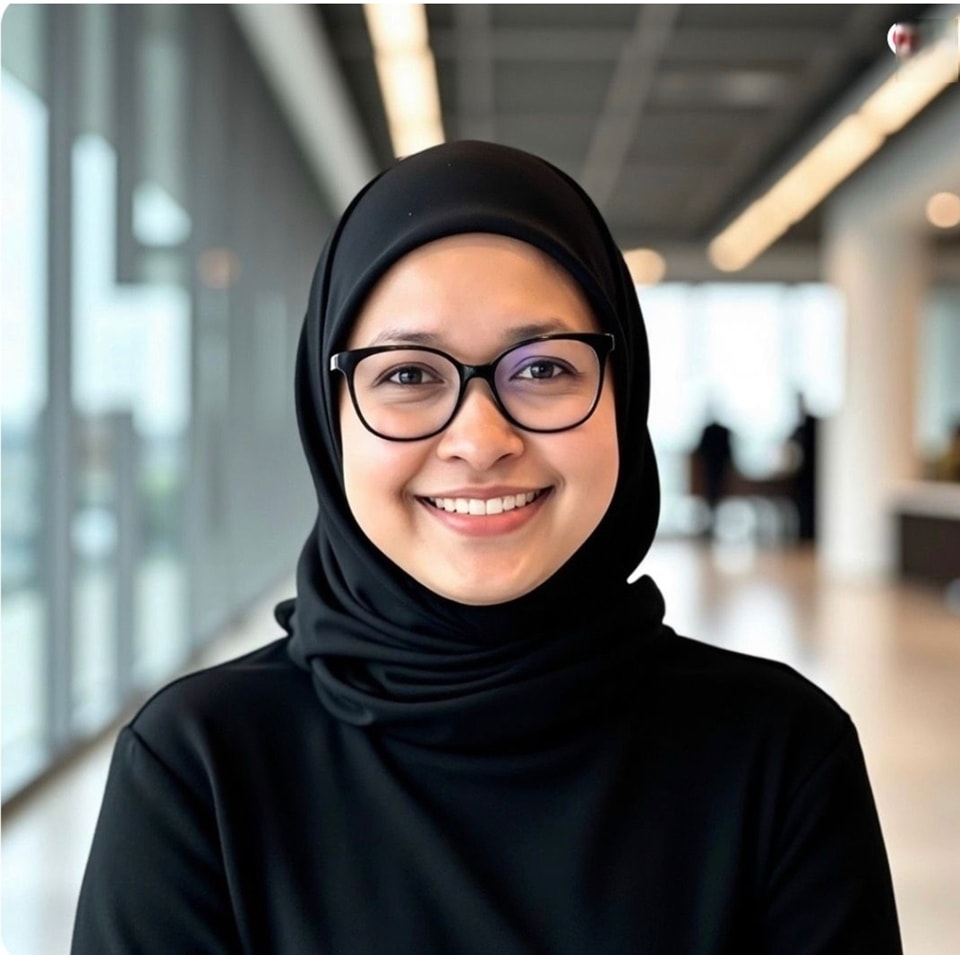
Fatin Nabilah Azren
Fatin Nabilah Azren is a PhD student in the Carnegie School of Sport. Her PhD explores Muslim women’s experiences as sports spectators in Malaysia, focusing on how they navigate spaces shaped by Islamic practices in sporting cultures.





