

Leeds Beckett University - City Campus,
Woodhouse Lane,
LS1 3HE
Dr Jill Gibbon
Emeritus
Jill Gibbon is an artist researching the aesthetics of defence and militarisation.
 0000-0002-7382-4647
About
Jill Gibbon is an artist researching the aesthetics of defence and militarisation.
Jill Gibbon is an artist researching the aesthetics of defence and militarisation.
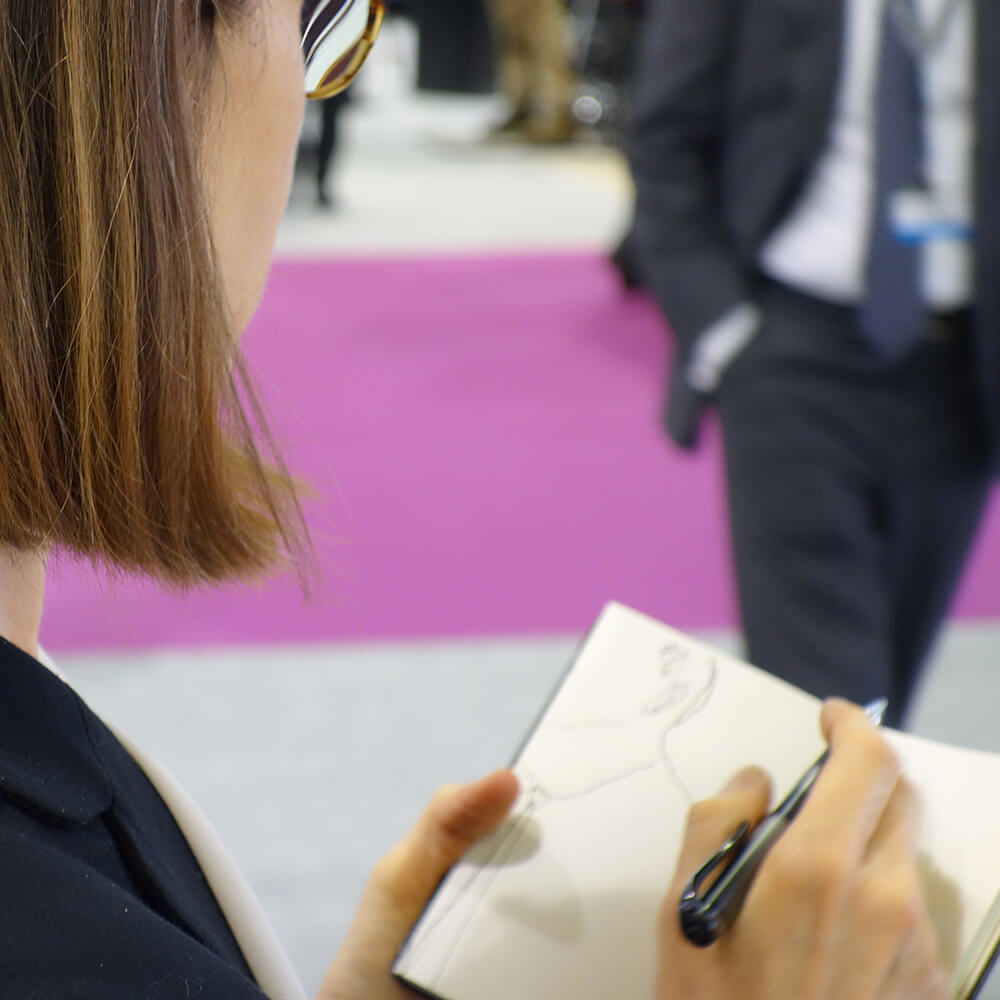
Gibbon uses drawing to research the defence industry, with a particular focus on marketing, hospitality and etiquette.
Related links
Research interests
Gibbon has published widely, and her work is in the permanent collections of the Imperial War Museum and Peace Museum. She has been interviewed about her research by the BBC, Guardian, and NPR.
Publications (45)
Sort By:
Featured First:
Search:
What do we want?
 07 April 2024
Exhibition curated by Olivier Cornet sparking public debate about peace security and war.
03 September 2019
Activist art exhibition running alongside DSEI arms fair
Seen Up Close, and from a Distance
08 March 2016
Seen Up Close and from a Distance shows new work by women artists based in the North of England. Installation, drawing and film explore aspects of physical, personal and political spaces. Curated by Steph Fletcher.
30 January 2023
Black Book: Drawing and Sketching3(1):54-63 AP2
This article discusses the challenges and potential of drawing as a method of political reportage. Using my experiences drawing at the arms fair Eurosatory 2022 as an example, I focus on a growing industry in ‘less lethal’ weaponry, equipment for repression. This industry is difficult to document because it is so discrete, with tear gas packaged in neat cannisters, riot gear worn by calm-faced mannequins, and sales staff politely welcoming repressive regimes. The problems are compounded by my own participation in the polite performance in order to stay in the event. I explore the potential of drawing to disrupt the marketing.
Drawing the Panopticon; representation, resistance and surveillance
06 April 2017
Association of Art Historians Annual Conference Loughborough Loughborough
Gibbon, J. (2017) ‘Drawing the Panopticon’ at the Association of Art Historians Conference, Loughborough 6th April 2017. The paper explored the relevance of drawing in a digital age, and included a re-reading of the Adorno, Brecht, Benjamin debate about realism and politics from a contemporary perspective. Abstract: What value is the most basic drawing technology - a notebook and pen, in the face of C21st surveillance? The development of watching and listening technologies combined with the diversification of the arms industry into security, and the privatization of public spaces has led to a society of the Panopticon (Foucault, 1991). New systems of ‘behavior analysis’ identify any unusual behavior in a crowd including loitering, running and, even, drawing. Meanwhile the ubiquity of mobile phone cameras and online social media encourage us to take part in our own surveillance. Using my practice as a starting point, this paper suggests that reportage drawing might offer a way to look back at, document and subvert the surveillance state, while reclaiming public space. Additional examples include John Berger’s altercation with a security guard at the National Gallery, where the act of drawing became a protest against new legislation imposed in the ‘war on terror’ (Berger, 2015). The paper challenges apolitical connotations of representational drawing by returning to mid C20th debates about aesthetics and politics (Bloch et al, 2008). I argue that Walter Benjamin’s discussion of Brecht’s epic theatre offers an alternative approach to representation, particularly in the use of gesture and interruption, and that this might be a starting point for a radical method for a reportage drawing.
01 January 2017
Millennium: Journal of international studies45(2):249-257 SAGE Publications
 Gibbon J, Sylvester C
In Method Meets Art (2015), Patricia Leavy argues for thinking like both a researcher and an artist in order to create socially useful works. Christine Sylvester teams up with visual artist Jill Gibbon to think through one of her drawings and practices that can radicalize art/war consciousness and motivate action. Both authors bear in mind words George Grosz screamed nearly100 years ago: "What does it matter if you spend your time gold-plating the heels of boots or carving Madonnas. People are being shot…” The essay unfolds from a brief remembrance of debates about art and function and considers what it is to think like a researcher-artist (or not, as is often the case in IR war studies and art making) on issues of war. The co-authors then present separate viewpoints on the drawing and end by working together toward a researcher-artist mode of being, doing and thinking about war through art.
Constructing History - Reportage Drawing and Factography
04 December 2015
Valenciennes, France
Constructing History – reportage drawing and factography; a conference paper presented at the Illustrating History, Valenciennes 4/12/15. This paper uses art history, practice and theory to retrieve constructivist traditions of reportage, and challenge the assumption that an illustrator simply records events.
Undercover drawings of the arms trade
The Etiquette of the Arms Trade, Research Station
01 October 2017
The Etiquette of the Arms Trade, Research Station, Leeds Beckett University, October 1st – December 31 2017. An exhibition experimenting with methods of displaying notebooks and objects from the project The Etiquette of the Arms Trade, supported by a catalogue, in preparation for an exhibition at The Bradford Peace Museum in 2018.
Hiding in the Light, drawings of the arms trade
23 June 2015
Masquerades of War Routledge
Authors: Gibbon J, Editors: Sylvester CGibbon, J. (2015) ‘Hiding in the Light, drawings of the arms trade’ in Sylvester, C. (ed) Masquerades of War, London: Routledge. This chapter discusses the covers I use to get into arms fairs, and the ways they mirror performances of respectability in arms dealing.
23 July 2020
Spaces of War, War of Spaces Bloomsbury Academic
Authors: Gibbon J, Editors: Maltby S, O'Loughlin B, Parry K, Roselle LThis chapter focusses on a series of complimentary gifts that Gibbon collected from arms fairs in London, Paris, and Abu Dhabi, 2014 – 2020 by masquerading as an arms trader. They include soft tanks, a toffee in a wrapper saying ‘welcome to hell’, a condom with the slogan ‘the ultimate protection’, and stress balls in the shape of grenades, a soldier’s head, and a bomb. Gibbon asks whether the gifts can be appropriated through art to give insights into the arms industry. The bomb-shaped stress ball does not look like a contemporary weapon. A black sphere with a string fuse, it is a symbol for a bomb, a sign. Soft and pliable, it embodies the shifting meanings of bombs in arms fairs as symbols of power, vehicles of profit, objects of exchange. The stress ball epitomises the arms industry’s disavowal of the material impact of weapons. Using Barad’s (2003) concept of materiality as a performance entangled with meaning, Gibbon argues that the gifts take part in the deceptive charades of the defence industry, where the material properties of weapons are disavowed. Gibbon contextualises her method of exhibiting the gifts in relation to the Dada readymade, and Magritte’s Treachery of Images, where spaces of art are used to highlight the material qualities of an object. She considers whether it is possible to use the gifts to reveal the commodification of weapons, or if they have the last laugh.
22 September 2022
Lyotard and Critical Practice Bloomsbury
Authors: Gibbon J, Editors: Bamford K, Grebowicz M 25 August 2022
Visual Activism in the 21st Century: Art, Protest and Resistance in an Uncertain World Bloomsbury
Authors: Gibbon J, Editors: Hartle S, White DThe Etiquette of the Arms Trade
26 September 2018
Relating Pasts & Presents; history of science and social science Max Planck Institute, Berlin
This paper explores the masquerade of respectability in the arms trade. I argue that etiquette has been largely overlooked in social science research about the arms industry because it is aesthetic; it is enacted, performed and displayed. In contrast, methods from art such as drawing and performance are particularly suited to researching the rituals of manners, hospitality and dress.
2018
Nottingham Beam Editions
The Etiquette of the Arms Trade is the first comprehensive collection of drawings by artist Jill Gibbon. Selected from a ten year period, the drawings document the corrupting culture of the world’s largest arms trade shows. The book includes two essays by the artist 'The Etiquette of the Arms Trade' which places the project in the context of the globalised arms industry, and 'Drawing as Reportage' that explores the role of drawing in contrast to photography.
13 April 2018
For the past ten years Jill Gibbon has visited arms fairs in Europe and the Middle East by masquerading as an arms trader with a suit, paste pearls, and a sham business. Once inside, she draws and collects complementary gifts. The exhibition explores the etiquette of the arms trade through the drawings, gifts, photographs of her performance, and elements of her masquerade.
This is Not a Bomb; matériel culture and the arms trade
22 May 2018
Spaces of War, War of Spaces Florence
Gibbon J, Tom FThis paper concerns a selection of gifts collected from arms fairs, trade shows for military equipment, in Europe and the Middle East. They include stress balls in the shape of bombs, mortars, and grenades; tanks made of foam rubber; a facsimile ammunition shell, hollow, with an orifice so it can be used as a whistle; a condom with the slogan ‘the ultimate protection’; and a toffee with the logo ‘welcome to hell’. We will suggest that the gifts give insights into the way weapons are regarded in the international arms industry. The bomb shaped stress ball does not resemble a contemporary bomb. A black sphere with a string fuse, it evokes a cartoon idea of a bomb. It refers to a bomb as a sign. We know from Saussure that signs have shifting meanings. In an arms fair, bombs also have shifting meanings. They are presented as seductive objects, a focus for personal and state power, international and corporate co-operation, defence, and jobs. In short, they are treated as commodities. It was Marx’s insight that the ‘use value’ of a commodity is eclipsed by its ‘exchange value’. A site of shifting values and meanings, a commodity has a similar status to a semiotic sign. The authors make sense of this in relation to the ‘material turn’ an emphasis on the agency and properties of materials in the arts and social sciences. They also consider what happens when the gifts are appropriated as art, and the extent to which it is possible to subvert their original function, using them to give insights into the arms trade.
The Etiquette of the Arms Trade, ten years drawing in arms fairs
What do we want?
05 August 2024
Touring exhibition curated by Olivier Cornet exploring peace, security and war.
Drawing, performance, and war
20 February 2019
University of Gloucester
Talk given as part of Drawing Through Time and Image
Drawing and the Politics of Seeing
06 June 2017
University of Gloucester
Gibbon J, Southern JTalk given as part of The University of Gloucester Festival
Art and War, Truth, Propaganda, Protest
Drawing the Arms Trade
20 February 2010
Theory Versus Policy, International Studies Association Annual Convention New Orleans
The Art of Infiltration
Radical Reportage
Witnessing War from New Perspectives
The War Artist as Trickster
Jerwood Drawing Prize
War and the Body
Indig-nation
The War and the Body Exhibition, Showing, Sharing, Shaping
01 June 2012
War and Culture Studies5(1):105-125 (20 Pages) University of Westminster
Authors: Maltby S, Pratt S, Gibbon J, Editors: Maltby S, McSorley KArtist talk
Dilemmas of Drawing War
Artist talk
The Art of the Arms Deal
Artist talk
Transcriptor: Illustration, Documentary and the Material
19 October 2017
Lawlor V, Rolf V, Kugler O, Sabnani Nn a period of ever increasing modes of capturing, documenting, commenting on contemporary life, society and environment there continues to be a visual presence and use of the illustrated. The exhibition explores the diverse forms of documentary illustrative practice that push and at times transcend perceived ideas and values of what could be considered documentary/reportage forms.
And This Too
03 November 2017
Gibbon JAnd This Too, Platform Gallery, Belfast November 3rd - 30th 2017 A group show of art using conflict as a central theme, curated by Gail Ritchie. I contributed sketchbooks, photographs, and artefacts from The Etiquette of the Arms Trade. I was part of a panel discussion at the gallery on November 3rd, alongside Dr Des O’Rawe, Queens University, and aritsts Brendan Jamison and Gail Ritchie.
From Nope to Hope: Art Vs Arms, Oil, and Injustice
15 September 2018
Jill G, Nope to Arms C, Adams RAn exhibition of graphic design, craft and grassroots resistance.
Krieg. Macht. Sinn.
01 November 2018
Cercel CThe wars of the past century have been deeply engraved in our cultural memory. One hundred years after the end of the first world war, the exhibition attempts to take a completely new look at the phenomenon of war and violence.
Transcriptor: Illustration and Documentary the Material
19 October 2017
Gibbon JTranscriptor: Illustration and Documentary the Material. James Hockney Gallery, University for the Creative Arts, Farnham, Surrey October 19th -December 2017. A group show exploring drawing as a documentary medium, curated by James Walker, with artists, Veronica Lawlor and Oliver Kugler. I contributed ten sketchbooks and four prints from the Etiquette of the Arms Trade project.
Bomb Boutique
11 September 2021
Art the Arms Fair Women, Visibility and Playful Acts
26 February 2016
F= FRGShock and Awe
19 July 2014
Gibbon JShock and Awe, Royal West Academy, Bristol 19/07/14 - 17/09/14 I was invited to take part in a group exhibition of war art curated by Paul Gough to coincide with a major show of paintings by John and Paul Nash in the same gallery, and national commemorations of WW1. I included an installation of sketchbooks drawn undercover in arms fairs, a wall sized ‘graphic-novel’ based on the drawings, and gifts collected at these events. My contribution to the exhibition was covered by The Guardian 27/07/14, the BBC World Service 29/07/14, and Al Jazeera 22/08/14 where the drawings were described as giving insights into the culture of the arms trade, and linked to revelations about British and French firms’ deals with Russia. I gave a gallery talk about my work at Art and War: Truth, Propaganda and Protest, with David Cotterell and Dr Grace Brockington at the Royal West Academy 09/08/14.
Activities (1)
Sort By:
Featured First:
Search:
 Featured
The Dial
Current teaching
Gibbon teaches on the BA in Illustration, and supervises PhDs in art practice and theory.
Grants (1)
Sort By:
Featured First:
Search:





