

Leeds Beckett University - City Campus,
Woodhouse Lane,
LS1 3HE
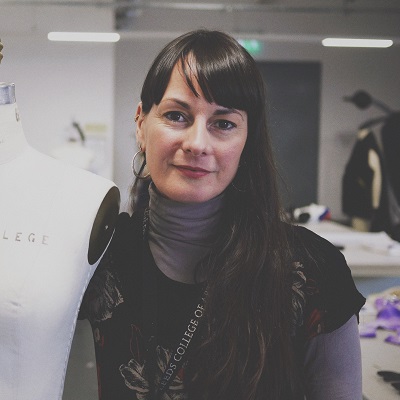
Sam Hudson-Miles
Course Director
A fashion academic and PhD student. MA in Fashion Design from Central Saint Martin's (1994). Director of eponymous label and CMT facility (1996-2000). Career as a fashion educator, teaching on, leading, and designing new undergraduate fashion design programmes (2000-present).
 0000-0002-0978-6471
About
A fashion academic and PhD student. MA in Fashion Design from Central Saint Martin's (1994). Director of eponymous label and CMT facility (1996-2000). Career as a fashion educator, teaching on, leading, and designing new undergraduate fashion design programmes (2000-present).
Sam Hudson-Miles is a senior academic and PhD student working in the field of fashion and textiles.
After completing an MA in Fashion at Central Saint Martin's School of Art during the early 1990's, Sam launched her eponymous label alongside a CMT (Cut, Make, Trim) facility for small UK-based production runs, usually for emergent independent designers. In the year 2000, she embarked on her teaching career as a fashion educator, teaching on, and leading, several undergraduate fashion design programmes. Throughout her academic career, she has developed a number of new programmes, her most recent being a BA (Hons) Sustainable Fashion.
Sam's PhD research draws upon insights from material culture scholarship to the analysis of vintage garments sourced from local charity shops and flea markets in the West Riding of Yorkshire, over a thirty-year period. Her research methodologies are developing an original theory of soul shopping, with the intention to contribute to post-growth attitudes toward fashion consumption, broadly addressing 'usership' of clothing as a relational lifestyle within the context of the circular economy.
Research interests
Sam's PhD research draws upon insights from material culture scholarship to the analysis of vintage garments sourced from local charity shops and flea markets in the West Riding of Yorkshire, over a thirty-year period. Her research methodologies are developing an original theory of soul shopping, with the intention to contribute to post-growth attitudes toward fashion consumption, broadly addressing 'usership' of clothing as a relational lifestyle within the context of the circular economy.
Publications (25)
Sort By:
Featured First:
Search:
MAGAZINE TITLE: SEWING THE SEEDS: FASHION ACTIVISM IN THE NORTH OF ENGLAND FEATURE TITLE: RE.PAIR LAB
 20 October 2024
MAGAZINE FASHION REVOLUTION8:9-11 (3 Pages) Publisher
20 October 2024
MAGAZINE FASHION REVOLUTION8:9-11 (3 Pages) Publisher
 Authors: Hudson-Miles SAMANTHA, Editors: Hudson-Miles S, Hudson-Miles R
Following the success of their renowned Fanzine series, Fashion Revolution partnered with Leeds Beckett University in April 2024 to produce a magazine dedicated to the fashion activists of Northern England. The magazine is called Sewing the Seeds: Fashion Activism in the North of England. For this issue, I wrote a feature titled My Perfect Piece. My Perfect Piece is a show and tell workshop that celebrates the sentimental value of our clothing. Participants are invited to wear, or bring, an item of clothing, or an accessory, to which they have some kind of sentimental attachment. In an informal group setting, each participant shares the memory, and user-ship of their piece. These workshops have not only provided qualitative data for my research but have brought together a nano-community of soul-shoppers who, otherwise, may not have met. New levels of bonding have been formed with those participants who are already friends, or work colleagues, simply through sharing stories about pieces of clothing that hold treasured memories. From a seemingly mundane Puffa jacket to a Tyvek paper Kiss jacket gifted by a friend, to a ring lovingly carved from an old pipe to Ann’s Amulet, a deeply cherished brooch personally gifted by fashion designer, and one of the Antwerp Six, Ann Demeulemeester…these conversations have given more richness, more meaning, more thinking, more potentiality, to my research. Fashion Revolution are the leading organisation campaigning for a more ethical fashion industry. Their Fashion Transparency Index has become the leading tool to force the world's fashion brands to be more transparent about their social and environmental efforts. Fashion Revolution also organise Fashion Revolution Week. This is an annual campaign event which brings together Fashion revolution's 75 country network for seven days of activism. We hope the ideas contained in Sewing the Seeds, will be the catalyst for new collaborative co-research and new forms of activism. The magazine can be purchased here: https://www.fashionrevolution.org/resources/sewing-the-seeds-zine/
WORKING CLASS HERO
27 November 2023
MAGAZINE16:87-88 (2 Pages)
Authors: Hudson-Miles SAMANTHA, JONES N, Editors: Hudson-Miles SFollowing the success of the partnership that I initiated between Leeds Beckett University and ASBO Magazine in May 2022, I was invited to guest edit Issue 16, the 2024 Special International Graduate Issue. I took this opportunity to pay homage to the independent fashion ecosystem in and around Leeds which would go on to lay the foundations for ASBO Magazine’s sister publication, ASBO North, and catalyse the Graduate Fashion: North initiative.
EVERTON CAMPBELL: BUSINESSMAN, FOUNDER OF HIP and 2nd ACADEMIC
27 November 2023
MAGAZINE16: SPECIAL INTERNATIONAL GRADUATE ISSUE:183-185 (3 Pages)
Authors: Hudson-Miles S, CAMPBELL E, Editors: Hudson-Miles SFollowing the success of the partnership that I initiated between Leeds Beckett University and ASBO Magazine in May 2022, I was invited to guest edit Issue 16, the 2024 Special International Graduate Issue. I took this opportunity to pay homage to the independent fashion ecosystem in and around Leeds which would go on to lay the foundations for ASBO Magazine’s sister publication, ASBO North, and catalyse the Graduate Fashion: North initiative.
LEEDS BECKETT UNIVERSITY: ONES TO WATCH
27 November 2023
MAGAZINE
Authors: WHELLAR D, Hudson-Miles SAMANTHA, Editors: Hudson-Miles SFollowing the success of the partnership that I initiated between Leeds Beckett University and ASBO Magazine in May 2022, I was invited to guest edit Issue 16, the 2024 Special International Graduate Issue. I took this opportunity to pay homage to the independent fashion ecosystem in and around Leeds which would go on to lay the foundations for ASBO Magazine’s sister publication, ASBO North, and catalyse the Graduate Fashion: North initiative.
JOHN MOORES: ANOTHER PERSPECTIVE
27 November 2023
MAGAZINE16: SPECIAL INTERNATIONAL GRADUATE ISSUE:163-164 (2 Pages)
Authors: IBI A, Hudson-Miles SAMANTHA, Editors: Hudson-Miles SFollowing the success of the partnership that I initiated between Leeds Beckett University and ASBO Magazine in May 2022, I was invited to guest edit Issue 16, the 2024 Special International Graduate Issue. I took this opportunity to pay homage to the independent fashion ecosystem in and around Leeds which would go on to lay the foundations for ASBO Magazine’s sister publication, ASBO North, and catalyse the Graduate Fashion: North initiative.
JOHNNY CARR: PHOTOGRAPHER and FILMMAKER
27 November 2023
MAGAZINE16: SPECIAL INTERNATIONAL GRADUATE ISSUE:149-150 (2 Pages)
Authors: Hudson-Miles S, Editors: Hudson-Miles SFollowing the success of the partnership that I initiated between Leeds Beckett University and ASBO Magazine in May 2022, I was invited to guest edit Issue 16, the 2024 Special International Graduate Issue. I took this opportunity to pay homage to the independent fashion ecosystem in and around Leeds which would go on to lay the foundations for ASBO Magazine’s sister publication, ASBO North, and catalyse the Graduate Fashion: North initiative.
THE 50p LBD
27 November 2023
MAGAZINE16: SPECIAL INTERNATIONAL GRADUATE ISSUE:203-209 (7 Pages)
Authors: Hudson-Miles S, Editors: Hudson-Miles SFollowing the success of the partnership that I initiated between Leeds Beckett University and ASBO Magazine in May 2022, I was invited to guest edit Issue 16, the 2024 Special International Graduate Issue. I took this opportunity to pay homage to the independent fashion ecosystem in and around Leeds which would go on to lay the foundations for ASBO Magazine’s sister publication, ASBO North, and catalyse the Graduate Fashion: North initiative.
Soul-Shopping: Autoethnography, Upcycling, and Post-Growth Fashion
15 June 2021
State-of-the-Art Upcycling Research and Practice State-of-the-Art Upcycling Research and Practice: Proceedings of the International Upcycling Symposium 2020 Sung K, Singh J, Bridgens B De Montfort University Springer, Cham
Authors: Hudson-Miles S, Editors: Sung K, Singh J, Bridgens BUpcycling transforms the historically dominant, but increasingly exhausted, linear producer–consumer–waste model of the fashion ecosystem into something more circular. The recent rise in fashion upcycling transcends stereotypical perceptions of Do-It-Yourself (DIY) needlecraft or thrift. Mainstream fashion retailers offer incentives to customers for returning their unwanted clothes to store in return for a gift card, with some garments returning to the production cycle, for reinstatement in-store, and re-marketisation as exclusive upcycled fashion. Although this contributes to the upcycling movement, it misses the core ethos that the upcycling of fashion should not only contribute ‘to sustainable shopping as a whole, but also serve as art pieces, cultural commentary and a sense of connection’. This chapter introduces how to disrupt the fast-fashion system by reducing mindless fashion consumption, not from the point of design and production, but from that of the consumer; not as the end-point of the supply chain, but as the driver of the chain, whereby demand dictates supply—through the practice of soul-shopping.
Reconnecting practice: pedagogies of fashion thinking
07 April 2020
The Sustainable Apparel & Textiles (SAT) in the Circular Economy Online Symposium Sustainable Practice: Textiles, Apparel & the Circular Economy The University of Huddersfield University of Huddersfield, UK University of Huddersfield Press
Broadly speaking, the issue of sustainability in the fashion industry is nothing new (Fletcher, 2016; Gwilt,2014; Siegle, 2008), and it continues to gain momentum; unsurprising, given that, despite the warnings, there are more garments in circulation than ever. However, although the inherent problem with ‘Fast Fashion’ lay in the over-production and over-consumption of clothing, to, ultimately, satisfy the consumer’s desire, we cannot blame the consumer. We must return to the first stage of the cycle; the designer, and contemplate how we, the educator, can awaken the student’s relationship to their practice, with a sustainable and conscious mind-set. In her 2015 Anti_Fashion Manifesto for the next decade, Li Edelkoort (2015) stated that we are witnessing “the end of fashion as we know it”, making reference to the impact of ‘Fast Fashion’ on the future drivers of the fashion eco-system; today’s ‘Generation Y’ fashion design students. Edelkoort declares that the expectation to create accessories, brochures, to arrange shows, photography, and communications, only serves to dilute the essence, and purpose, of 21st century, sustainable, fashion design thinking. Within a year of the publication of Edelkoort's manifesto, Kate Fletcher's 'Craft of Use' (2016) project paid homage to the 'tending and wearing' of garments as much as their creation, revealing the expression of fashion 'in a world not dependent on continuous consumption', where garments, whilst 'sold as a product, are lived as a process'. This paper considers these two globally renowned fashion educators’ predictions and practices and demonstrates ways in which their influence has served as a bedrock in the advancement a BA (Hons) Fashion curriculum, in the context of sustainability, and a conducive re-alignment of fashion design thinking and practice, pedagogically. A case study will demonstrate the methodologies applied by a final year BA (Hons) Fashion student through a graduate collection that articulates a holistic approach to sustainable design practice. From mindful practice at the initial stages of exploration, to a collection that takes a non-binary approach, not only in its aesthetic, adaptable sizing and fit offer, but in offering solutions to wider social, economic, and consumptive issues.
Bricolage in fashion and textile subcultures
2024
Bloomsbury Encyclopedia of World Textiles Bloomsbury
Authors: Hudson-Miles S, Hudson-Miles R, Editors: Jefferies J, Richmond VMY PERFECT PIECE: Sharing Stories about Loved Clothes
July 2014
Following the 'I Am' exhibition at Leeds City Art Gallery earlier in 2014, and inspired by Kate Fletcher's Local Wisdom project, and, later, her 2016 publication, Craft of Use: Post-Growth Fashion, I led on a participant-based research project that invited contributors to display their 'perfect piece' and describe their connection to/with it. This project, and the findings from it, became the catalyst, and focus, for further research, and ultimately, my PhD study.
The Way We Wear
March 2021
IGTV Publisher
Hudson-Miles S, Ekardt KHaving started to establish my own Instagram page @the.rerunway during lockdown 1.0, new connections with like-minded sustainable fashionistas developed. One of these was with Kelly Ekardt (@kellyekardt), a fashion stylist and all-round creative, currently living in Frankfurt. Following a Zoom meeting to chat about all things sustainable fashion, we became very excited and decided to launch a 3-episode IGTV series, titled The Way we Wear. The episodes went live during lockdown 3.0, covering topics such as spirituality, psychology, and well-being, in the context of fashion design, styling, and 'usership' of our clothes. The episodes can be found at Kelly's IGTV channel @kellyekardt, with snippets on my Instagram page @the.rerunway
Re-wiring Practice: A Conscious Pedagogy
06 October 2019
Futurescan 4: Valuing Practice Conference Contribution Almond K, Britt H, Morgan L University of Bolton
Authors: Hudson-Miles S, Editors: Almond K, Britt H, Morgan LThis short paper considers ways in which three esteemed and globally renowned fashion educators’:Lidewij (Li) Edelkoort, Kate Fletcher and Timo Rissanen, have influenced the holistic advancement of aUKundergraduate fashion design curriculum, a course that places sustainablepracticeas integral to its core ethos.The paper will identify how the tacit and explicit nature of‘conscious’ and ‘pre-conscious’learning, more specifically, the concept of ‘habitus’, exists in fashion design students’ sustainable practice, typically through the journey of their graduate collections.
Instagram profile @the.rerunway
2020
Website
During lockdown 1.0, my son, Hāfiz returned home to stay with me for several months. During this period, we launched an Instagram page, @the.rerunway. The Re Run Way disrupts fast-fashion consumer culture through choosing to buy second-hand, loving our clothes, and sharing stories of the 'perfect piece'. Although, in its early stages, this was a collaborative project, the page is still live and contributes to my PhD research, and furthers my networking with likeminded individuals, through its engagement with a broader demographic with interests / practices in the field of sustainable fashion and textiles. In 2025 the page has been removed from Instagram.
THAT dress: soul-shopping as a ‘maker’s methodology’ for post-growth fashion design practice
09 March 2022
WSA Sustainability Forum Winchester School of Art, UK
My PhD research explores themes of post-growth fashion and emotionally durable design through autoethnographic, participatory, co-creative, and object-based methodologies. The research is centred within a defined locale of Dewsbury, a once thriving textiles hub and market town within the Heavy Woollen District of Kirklees, West Yorkshire. A personally collected and curated collection of second-hand vintage clothing, purchased from charity shops, and over a 3-decade period, is the nucleus for developing a theoretically grounded practice of ‘soul-shopping’. By defining a ‘maker’s methodology’, the research aims to contribute to the circular economy by addressing 'the environmental impact caused, not only by the fashion supply chain, but also the ways in which fashion is used' (Fletcher & Tham, 2019, p.6), thus leveraging the wider fashion revolution, and contributing to an emergent fashion eco-system.
Revolution Fashion Artisan
10 July 2016
Leeds Independent Life2:92-93 (2 Pages)
Authors: Hudson-Miles S, Editors: Laycock DThe fashion industry is in the midst of a shift; the impact of 21st century fashion democratisation has led to a cycle of relentless show schedules and the trickle-down fallout of an over-saturated High Street, which some would argue has altered the perception of fashion by the consumer and all but obliterated individual fashion identity. It’s an unsurprising but thought-provoking fact that an item of clothing can cost less than a sandwich. This egalitarian model has its advantages; however, the disadvantages, for instance unethical working practices and conditions, have become well-publicised over recent years, and gone some way to raise awareness and effect change within both the fashion industry supply chain and consumer behaviour. From a psychological consumer perspective, the tendency to mindlessly consume clothing, in automated response to the perpetual Fast Fashion cycle, has given rise to a disinterest in the emotive connection with the clothing we buy and wear, from which, albeit passively, a homogenised non-identity has emerged. Our Fashion students will be the future drivers for change in the fashion industry. As educators, the crux is to recognise, and respond to, the pedagogical challenges of generational culture shifts, particularly in relation to an instantaneous, replete social media era, to inspire a deeper level of ‘fashion thinking’. Yes, the industry needs fashion graduates to work in the fast-paced environment of a multi-national, but an ever-increasing awareness of ‘slow-fashion’ practices and considerations is taking hold, along with the grass shoots of a consumer, and business, need for fashion artisans to produce beautiful, crafted, niche products. Connecting with practice, through the drawing of narratives and wider contextual references, will put our students into the world with a strong sense of identity and a clear sense of articulation, whether this be from a personal, social, political or ethical stand point.
'I Am': Fantasy and the Creating of Identities through Dressing-Up
April 2014
With a research focus on sustainability, and through exploring the impact of 'fast-fashion' on the consumer, and their connection with their clothing, a collaborative exhibition with Leeds City Art Gallery offered the opportunity to test-bed the research project and record the outcomes. Through its interactive and inclusive approach, and crossing boundaries of age, gender and culture, engaging with both adults and children, the exhibition encouraged self-expression and playfulness through the medium of fashion. Qualitative data was collected through the recording of responses from the participants in relation to: • why they had selected a particular item of clothing to wear; • how the wearing of that item made them feel; • why that feeling was evoked. Responses were recorded through photography, film and voice recordings and have informed further exploration into connotations of ‘personal narrative’ and ‘future artefact’. By recording stories relating to the connection of wearing a particular item of clothing, a meaning of 'value' becomes more conscious in the mind of the wearer / consumer, with the aim of, ultimately, slowing down their consumption of 'fashion'. Encouraging the 'consumer’ to connect emotively, sentimentally, ethically, to the choices they make when buying and wearing fashion, may result in the resurgence to considered choices, ‘slower’ fashion, and the celebration of diversity/individuality. Due to its popularity, this exhibition was extended from its initial 10-day duration to 4 weeks.
Mind the Fashion Gap
17 June 2018
Magazine Independent Leeds Magazine9:15 (1 Pages) Publisher
Authors: Hudson-Miles S, Editors: Laycock DLeeds’s heritage is steeped in the clothing manufacture industry. Rewind some 70 years, Leeds was the centre for garment production and tailoring by big names such as Burton’s and Hepworth’s, who made millions of suits for British men and were significant players in the production and retailing of men’s high street fashion after the Second World War. Since the late ‘80s, production moved first to Eastern Europe, then to the Far East, where it has predominantly remained. However, the fashion business website ‘Business of Fashion’ is talking about near-shoring being the new off-shoring, with garment production returning to Eastern Europe, from its almost 2 decade hiatus. This is helpful for smaller production runs and mid-sized companies, as Bulgarian and Romanian manufacturers tend to allow much lower production quantities compared to bigger producers such as China and Bangladesh. It’s a promising return to what was a viable logistical and financial option, before the Far East became the only option, and could be a catalyst for the return ‘on-shoring’.
Sewing the Seeds: Fashion Activism in Northern England
23 September 2024
Fashion Revolution Publisher
Authors: Hudson-Miles R, Roberts R, Thanaprasittikul S, Hudson-Miles S, Editors: Hudson-Miles R, Roberts R, Thanaprasittikul S, Hudson-Miles S 17 January 2024
Urban Futures - Cultural Pasts: Sustainable Cities, Cultures & Crafts, AMPS Conference Universitat Politècnica de Catalunya, Barcelona
AIM • To create a self-sustaining creative fashion ecosystem in the North of England as a contribution to cultural sustainability OBJECTIVES • To produce outputs for FABRICATE: Leeds Beckett's Fashion and Architecture research cluster • To develop a Graduate Fashion North event to rival London’s Graduate Fashion Week • To facilitate collaboration and creative knowledge exchange between leading fashion schools in Northern England • To prevent the ‘creative drain’ of talent to London • To celebrate the unique fashion cultures of Northern England.
ONE PLANET FASHION: PODCAST
March 2021
Spotify Publisher
Roebuck JAs I embarked upon my PhD journey during 2021, I met Julia Roebuck, founder of Upcycle Fashion (Instagram @upcyclefashion) through my engagement with sustainable fashion related conferences and forums. Through Upcycle Fashion, Julia 'works as a freelance sustainable fashion consultant and upcycle designer, creating new garments and accessories from unwanted textiles to communicate the importance, and joy, of re-use'. Julia and I had both been participants in the Chariocity project, and had also both presented at The University of Huddersfield's Sustainability Apparel & Textiles (SAT - in the Circular Economy) conference. At this time, Julia was in the process of launching her podcast series, One Planet Fashion (which can be found on Spotify), and asked me to be her very first guest! This episode centred around my PhD research, specifically the second-hand fashion purchasing practice of 'soul-shopping'.
CHARIOCITY: How Can Design Education Help To Revive The Charity Shop Sector, Post Covid-19?
January 2024
Centre for Circular Design CHARIOCITY: How Can Design Education Help To Revive The Charity Shop Sector, Post Covid-19? Publisher
Earley RChariocity was a UAL-funded knowledge exchange project, led by Professor Rebecca Earley, Professor of Circular Design Futures. The project aimed to uncover the impact of COVID-19 on the UK charity shop sector and to reimagine how systemic design education could help to 'build back better'. Running from January 2021 to July 2021 the project was structured around a series of four online workshops involving over 100 stakeholders from the charity shop and education sector. I was invited as a key contributor to the workshops, due to my own PhD research aligning with the aims of this project.
CHRISTOPHER RAEBURN: 'OFF-CUTS' WORKSHOP
July 2019
RAEBURN CAs part of the 2018 Leeds International Festival, I was invited, as a member of the technical team, to support Christopher Raeburn's, 'Off-Cuts' Owl workshop. The workshop was held in the Fashion Space, a shipping container positioned in the centre of Briggate, and formed one of a series of talks and workshops by fashion designers and creatives from across the UK. Each season, Christopher designs a new animal that sits alongside his collection, and is worked into bags and accessories - all made from fabric offcuts. He has taken the zoo on the road and presented pop up workshops in his REMADE HQ, allowing visitors to make their own up-cycled friends. Christopher describes his studio as "a collaborative, creative fashion studio where daily design meets painstaking production, alongside monthly events, discussions and workshops."
THE TRANSFER PROJECT: Fashion Conscious or Fashion Compulsive?
1 February 2015
Trinity Shopping Centre, Leeds, UK Centre for Sustainable Fashion, London College of Fashion, UAL the University of Sheffield (UoS) and funded by the ESRC. Publisher
Storey H, Harrison L, McIntosh A, Jones CIn 2015, I was involved in TRANSFER’s Pop-Up T-Shirt Factory project, as one of the ‘skilled makers’. TRANSFER is a joint initiative between the Centre for Sustainable Fashion, London College of Fashion, UAL the University of Sheffield (UoS) and funded by the ESRC. By unravelling the process of clothing manufacture, the team, which was made up of experts in psychology, management and fashion, aimed to help people reconnect with their clothing and show that there is a story and a person behind each and every garment that we own. The pop up factory highlighted just how many skilled people it takes and how much energy is needed to produce our clothing. By helping to bring the manufacturing process to life, the pop-up factory aimed to inspire consumers to love their clothes and treasure each and every piece for longer - whether it’s from the great British High Street or from a luxury brand. The team of machinists were led by Lizzie Harrison, a fashion designer whose brand Antiform first started in a studio in Hyde Park, Leeds. The team of interviewers included Professor Helen Storey CBE RDI and Centre for Sustainable Fashion, Business and Research Manager Alex McIntosh, Dr Chris Jones (Head of the Environment and Behaviour Research Group (EBRG), University of Sheffield) and Dr Natalie McCreesh (Fashion Communication, TUoS).
Editor's Introduction to 'Sewing the Seeds'
23 September 2024
Fashion Revolution Zine Fashion Revolution8:4-6 (3 Pages) Publisher
Authors: Hudson-Miles R, Editors: Hudson-Miles R, Roberts R, Thanaprasittikul S, Hudson-Miles SActivities (11)
Sort By:
Featured First:
Search:
 Featured
The University of South Wales The University of South Wales, UK Fashion
Featured
2023 & 2024 FASHION AS A FORCE FOR GOOD AWARDS SMARTWORKS CHARITY LEEDS United Kingdom
Featured
RESEARCH CLUSTER
Featured
Fashion
Featured
FTC FUTURESCAN 5: CONSCIOUS COMMUNITIES
Featured
FASHION
Featured
Higher Education Academy
Featured
The School of Design
Featured
Fashion
Featured
ASBO Magazine / D-Foundation ASBO Magazine / D-Foundation United Kingdom
Featured
EMPLOYER ENGAGEMENT WORKING GROUP
Current teaching
- BA (Hons) Fashion Design with a focus on final year
- MA Fashion
Teaching Activities (13)
Sort By:
Featured First:
Search:
BURBERRY 'BEST GRADUATE COLLECTION' AWARDS
01 June 2023
LEEDS BECKETT UNIVERSITY
Featured
Men's Tailoring re. Employer Engagement
October 2014
Leeds Arts University

BURBERRY: CREATIVE CONVERSATIONS
05 January 2024
LEEDS BECKETT UNIVERSITY
Featured
BA (Hons) Fashion
January 2022
Featured
TAILORING PRINCIPLES x ALEXANDER McQUEEN
September 2022
Leeds Beckett University
BURBERRY x LEEDS BECKETT FASHION: TAILORING
23 September 2024
LEEDS BECKETT UNIVERSITY
Featured
BA (Hons) Fashion Communication and Content
21 September 2026
Featured
MA Fashion Design
21 September 2026
Featured
BA (Hons) Fashion Marketing and Enterprise
21 September 2026
Featured
MA Fashion Communication
21 September 2026
Featured
BA (Hons) Sustainable Fashion
September 2022
Grants (1)
Sort By:
Featured First:
Search:
RE.PAIR LAB
News & Blog Posts
Leeds Beckett Students Set For Oxfam Batley Upcycling Fashion Exhibition - and London Fashion Week

Leeds Beckett Fashion students present graduate fashion show sponsored by Burberry

Top fashion industry names are front row for Leeds Beckett Fashion RUN graduate catwalk show

Leeds Beckett Fashion shows commitment to diversity and inclusivity for LEEDS 2023 events





