Leeds Beckett University - City Campus,
Woodhouse Lane,
LS1 3HE
Transforming a Global Supply Chain for the Net Zero Era: The QBOL KTP Journey
How can a business improve its operations, reduce its environmental impact and remain commercially competitive? This question is at the heart of the Knowledge Transfer Partnership (KTP) between Quality Bearings Online (QBOL) and Leeds Beckett University.
The project, Intelligent System for the Net Zero Era, brings together expertise from Dr Alfred Chinta at Leeds Business School and Professor Ah-Lian Kor at the School of Built Environment, Engineering and Computing, to explore how data, AI and sustainability can inform supply chain decisions.
As the project enters its final 12 months, KTP Associate Vignesh Kumar reflects on the progress so far and how sustainability and profitability can go hand in hand.
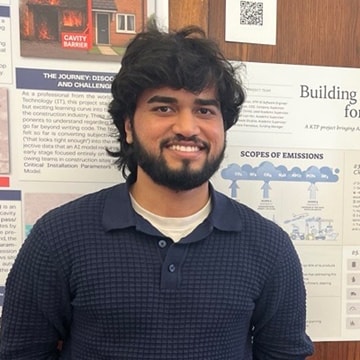

Hi Vignesh, can you tell us about your background before starting the KTP with QBOL?
Prior to joining the KTP, I spent several years in software engineering, including working in a startup, building full-stack applications and products. I worked closely with businesses to understand what they needed and build solutions to meet those needs.
One thing I really enjoyed was getting into the business side of things. It helped me see that building good software is about much more than writing code. You have to understand the problem you're solving and how your solution is actually going to help the business.
I went on to complete an MSc in Advanced Computer Science at the University of Leeds and wanted to combine my technical experience with my interest in how businesses work.
When I came across the KTP opportunity at QBOL, it seemed like the obvious next step: a chance to take ownership of a project and deliver solutions to real business problems.

Vignesh presenting his work at The Knowledge Exchange
What was the motivation for QBOL to start a KTP?
Around 90% of QBOL's products are shipped overseas, so the business is a significant player in the global manufacturing supply chain. Its focus on rapid, just-in-time fulfilment does, however, bring financial and environmental challenges.
As businesses come under increasing pressure to understand and reduce their Scope 3 emissions, QBOL wanted to explore how data and AI could help reduce its carbon footprint while improving operational efficiency.
Rather than seeing sustainability simply as a compliance issue, the business saw an opportunity to rethink how it operates and use data to balance customer service, cost and environmental performance.
What opportunities have you undertaken during the KTP?
Working with different teams at QBOL has given me real-world experience of the commercial side of decision-making. I've seen how purchasing, stock management, customer expectations and logistics all feed into each other, and how a change in one area can have knock-on effects elsewhere.
I've also had the freedom and trust to take ownership of my work, explore ideas and question the status quo. The best solution isn't necessarily the most technically sophisticated. It has to work for the people using it and make sense within the business.
I've completed Carbon Literacy training and am taking part in the Help to Grow: Management programme to develop my knowledge of management, leadership and business growth. I've also designed a student project and mentored the student through it, which has given me valuable experience of supporting someone else's development.

The LBU and QBOL team
What has been achieved so far?
Smarter packaging, lower carbon
Packaging was one of the first areas where I spotted an opportunity. Looking at how parcels were packed highlighted ways to reduce empty space and use materials more efficiently.
Working with packaging suppliers and the warehouse team, we explored different box sizes and materials, lighter promotional items and cardboard alternatives.
Our estimates suggest that reducing packaging weight could save around 45 tonnes of CO2 and £50,000 annually.
Rethinking the need for the fastest delivery
Fast, free delivery has always been a key part of QBOL's offer, but I wanted to find out whether customers would be prepared to wait a little longer if they were given the choice.
We ran a trial offering a slower, lower-priority delivery option for smaller orders, with faster delivery available at an additional cost. Surprisingly, 77% of customers chose the lower-priority service.
This challenged the assumption that customers always want the fastest possible delivery. Greater flexibility could also help QBOL rethink inbound purchasing and transport. Where lead times allow, for example, goods could potentially move by road rather than air freight, reducing both costs and emissions.
What I found particularly interesting was how a relatively simple change to customer delivery options could influence decisions right across the supply chain.
Making inventory decisions more informed
With around 60,000 product lines, deciding what to keep in stock and when to restock is a major challenge.
I've built forecasting tools that use stock levels and customer purchasing patterns to support replenishment decisions.
Slow-moving stock has reduced by around 10%, inventory turnover has doubled and we've also improved the proportion of customer orders that can be fulfilled directly from stock.
Better inventory management can free up working capital and warehouse space while reducing the need for emergency purchasing. It also provides a foundation for further decision-support tools incorporating supplier cost, lead times and environmental impact.
Bringing sustainability into business decisions
The KTP has also helped embed sustainability more firmly within QBOL's priorities. The company has launched QBOL.ONE, its sustainability arm, providing a platform for communicating and developing its environmental ambitions.
For me, the key is demonstrating the link between sustainability and everyday commercial decisions. Choices around packaging, transport and inventory all have an environmental impact, but they also affect cost, customer service and operational efficiency.

The LBU and QBOL KTP team
So, what's next?
As we move into the final year of the KTP, the focus is on building on what we've learned, bringing together more operational and supply chain data, developing our decision-support tools and improving how we measure and report environmental impact.
For me, the priority is making sure these tools are useful in the day-to-day running of the business. Their real value comes from helping people make better-informed decisions.
The experience has reinforced my belief that the most valuable technology solutions start with a proper understanding of the business problem and what solving it would actually mean for the business.