
Leeds Beckett University - City Campus,
Woodhouse Lane,
LS1 3HE

‘Faster than the Speed of Life’ – The Psychology of Slow Living by Dr Elliot Cohen
Modern life only seems to get more fast-paced, demanding and hectic. Is this inevitable or do we need to look at our responses to the world? In his new book Dr Elliot Cohen shows what we can we learn from religious and philosophical traditions about how calmer, less rushed lives and tackle our ‘velocentricity’.


With the recent excitement of Halloween, I’ve been thinking about monsters in classic horror movies. Have you ever paused to ponder why they hardly ever run?
While the pursued protagonist invariably screams and races away in breathless, abject terror (typically tripping and falling in the process) the pursuing monster proceeds at a calm almost leisurely pace, as if to say “What’s the rush? We all know how this is going to end…”
‘The source for this scene likely stems from the common anxiety dream of being chased – and a competent psychotherapist may well ask who or what are we truly running from?’
Our age remains ‘The Age of Anxiety’, as characterised in the Pulitzer Prize winning poem by W. H. Auden. Auden lamented the loss of tradition, spiritual sustenance and deeper meaning in a rapidly changing world whose inhabitants are all run ragged, anxious and exhausted. He wisely observed that ‘The world needs a wash and a week’s rest’.
Seventy-seven years after the publication of that poem, the underlying causes of and conditions for that anxiety have only been amplified and are rapidly accelerating. The new ubiquitous monster is the Monster Energy drink that promises us the capacity to keep pace.
Ours is the Digital Age, dominated by the all-pervasive algorithm and generative Artificial Intelligence. And our anxieties now extend far beyond our physiology and psychology into ever expanding virtual realms. This is the same age where the slogan ‘Move Fast and Break Things’ was taken as active encouragement as opposed to a cautionary warning.
Today we daily encounter the relentless, pathological pace of modern life, ruled over by an increasingly tyrannical trinity of ‘speed, efficiency and productivity’, and we’re beyond tired - we’re tired of being tired.
Slow Living – An Ancient Answer to a Modern Problem
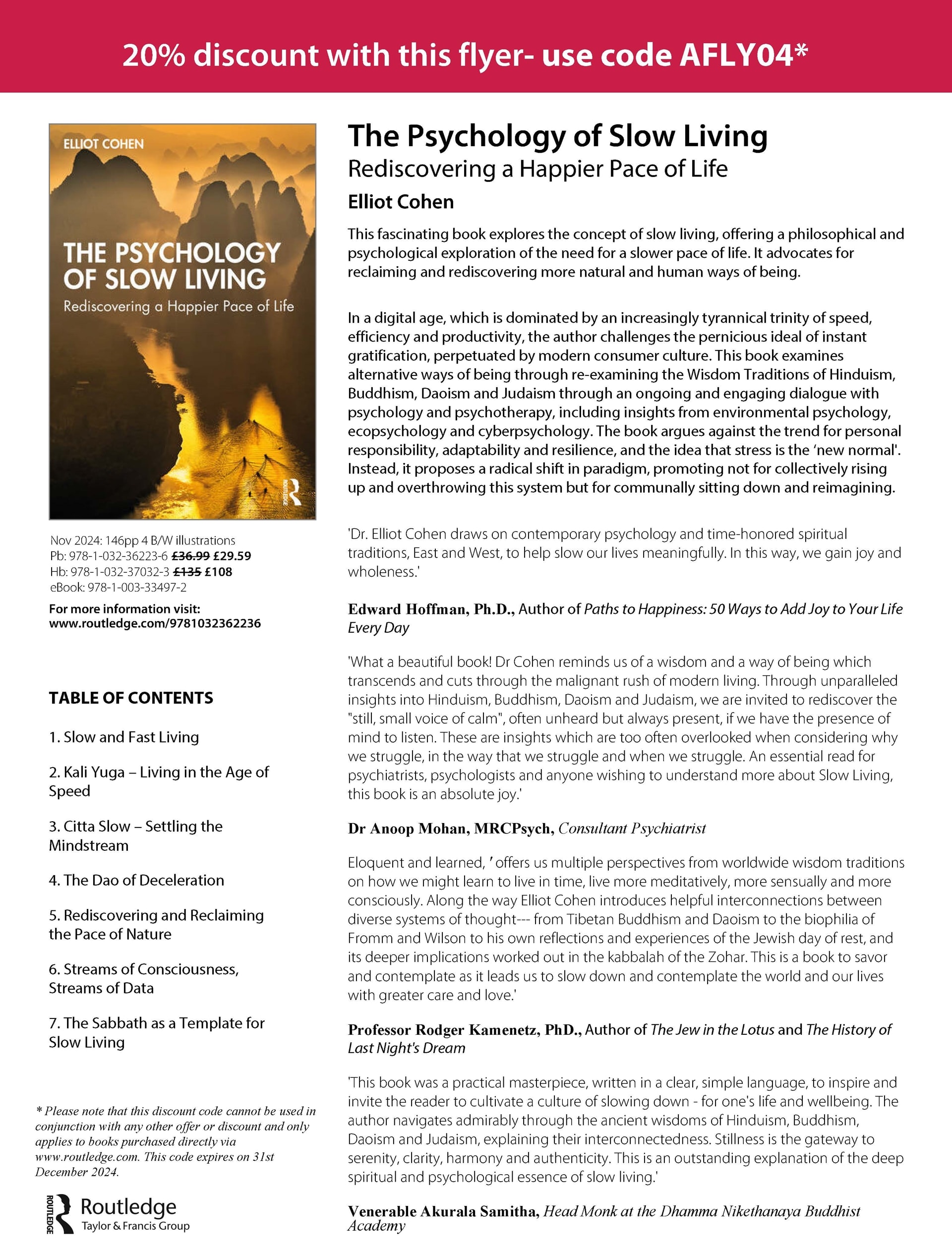
For over thirty years I’ve been studying the Wisdom Traditions of Hinduism, Buddhism, Daoism and Judaism. As a Transpersonal Psychologist I have not been merely passively researching these traditions, but rather actively immersing myself within them. The result of this immersion is my most recent book ‘The Psychology of Slow Living’.
Within these Wisdom Teachings I’ve encountered many ways to creatively counter our ‘velocentricity’ - our fixation with and fetishising of all things fast.
Hinduism taught me that we are currently living through the Kali Yuga – a chaotic age of darkness and speed, where we become unable to discern the truth from fiction, the real from the artificial. But the Hindu Vedas also speak of an ever-present stillness, a state of deep serenity and knowing that lies waiting to be discovered at the very core of our being.
Buddhism taught me how to tame and train my racing, chattering, monkey mind; revealing that the key to mindfulness (but not the shortcut) is slowing down.
Daoism encouraged me rediscover and realign myself with the pace of nature – leading to an abiding interest in deep ecology and ecopsychology.
Judaism, the religion of my birth, invited me back home to rest and reflect on the profound symbolism of the Sabbath, expressed through the idea and ideal of the Garden of Eden - a place of ‘perfect rest’ and harmony between humankind and the natural world.
All these traditions appear to ask the same question –
“Who are you running from?”
If we can stop or pause for a moment, we may well discover there was no monster chasing us - only our own fevered imaginings and racing ruminations. Ultimately, we run from ourselves because in our habitual haste we have forgotten who we are - Slow Living represents both a timely and timeless reminder.

Dr Elliot Cohen
Dr Elliot Cohen is a Chartered Psychologist and Associate Fellow of the British Psychological Society (BPS), and Fellow of the Higher Education Academy. He is the former Chair of BPS Transpersonal Psychology Section. He is the author of 'The Psychology of Slow Living' (2024) and 'The Psychologisation of Eastern Spiritual Traditions' (2021), both published by Routledge.





