

Leeds Beckett University - City Campus,
Woodhouse Lane,
LS1 3HE
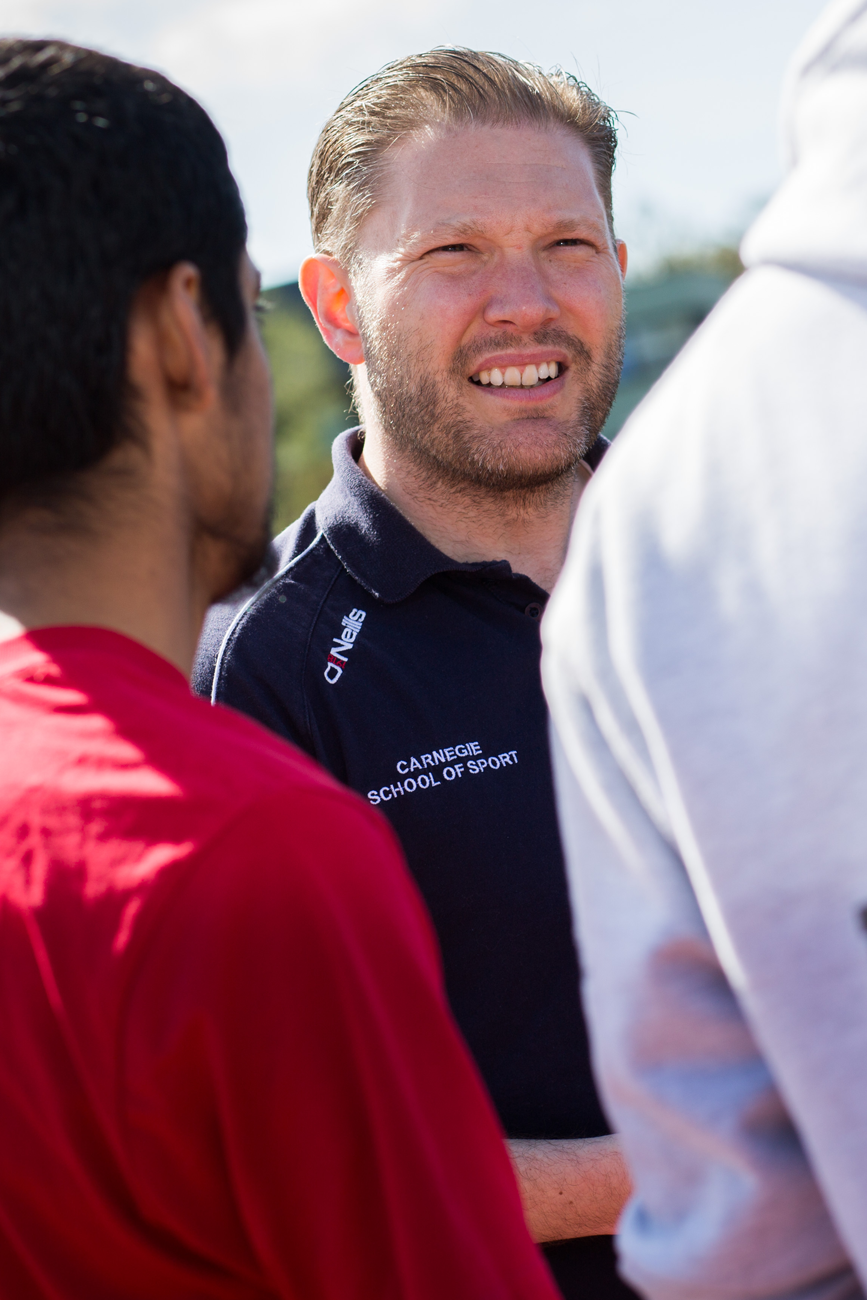
Jamie French
Course Director
Jamie is a qualified UK Athletics Coach Education Tutor with 12 years experience. His research interests include measuring health behaviours of young people as well as measuring the affects of physical activity on both physical and psychological health.
About
Jamie is a qualified UK Athletics Coach Education Tutor with 12 years experience. His research interests include measuring health behaviours of young people as well as measuring the affects of physical activity on both physical and psychological health. He is himself a graduate of Leeds Beckett having studied on the BA Physical Education going on to complete a Masters of Science Degree in Physical Activity and Health.
Jamie has coached athletics for 12 years and is a qualified UK Athletics Coach Education Tutor and his research interests include measuring health behaviours of young people as well as measuring the effects of physical activity on both physical and psychological health.
Research interests
Jamie's major research interests lie in the area of measuring young peoples healthy behaviours in a school setting and he is currently working with Education Leeds to develop a series of Health Behaviour questions.
Further to this, Jamie is also part of a long term National research project with the Department of Health looking at effective ways of promoting physical activity to a number of different target groups.
Jamie's other research interests include looking at the effect that physical activity has on the psychological well being of young people with a particular interest in exploring how physical activity can be used to manage depression.
Jamie is also very interested in researching how to increase aspects of performance in sprinting and horizontal jumps in athletics.
Publications (38)
Sort By:
Featured First:
Search:
Setting and effective learning environment
Coach Dependency - Making a Decision
It's worth it: Exploring parental stressors and coping strategies associated with financially supporting athletes on England's Talent Pathways in Sport.
 17 November 2016
Qualitative Research in Sport, Exercise and Health Taylor & Francis
17 November 2016
Qualitative Research in Sport, Exercise and Health Taylor & Francis
 Morley D, Whitehead A, Rongen F, Quarmby T, French J, Gilbert S, McKenna J
British Athletics Coaching Workforce Audit
Efficient Running
24 July 2014
Athletics Weekly56-57
Authors: French J, Long M, Cook B, Editors: Cook BFinal piece on efficient running technique focussing on coaching interventions
The Perfect Stride
17 July 2014
Athletics Weekly44-45
Authors: French J, Long M, Cook B, Editors: French JA brief review of running technique of Mo Farah
Running True to Form
10 July 2014
Athletics Weekly36-37
Authors: French J, Long M, Cook B, Editors: Long MBiomechanics of Endurance Running
Handle with Care
23 January 2014
Athletcis Weekly32-33
French J, Long MThe article focuses upon the difficulties athletics coaches have when tracking Long Term Development of Young Athletes
The Use of HIW in Endurance and Middle Distance Events
The Use of Questions in Coaching and Coach Education
Going Round the Bend
06 March 2014
Athletics Weekly48-49
Authors: French J, Long M, Editors: French JThis short paper explores the mechanical differences and subsequent technical implications of endurance running around an indoor 200m circuit. This is based on an interview with Jenny Meadows
Linking UKA Technical Models To Science To Aid Delivery
Science Behind Delivery - Running
Introducing Triple Jump to Developing Athletes
Holistic Child Development and Coaching
Holistic Child Development and Implications on Athletics Coaching
28 September 2013
England Athletics Annual Coaching Conference Leeds Metropolitan University
French J, Allan CHigh Intensity Exercise in a Middle Distance Context
It’s as easy as ABC
05 September 2013
Athletics WeeklySeptember:40-41 (2 Pages)
French J, Long MImproving throwing technique is all about honing agility, balance and coordination.
Knowing the physics of how object fly through the air can help field eventers
Leaping the Benefits
How to improve your VO2 max
Warming performance: Ground-breaking research into prior high-intensity exercise
Leap of Faith: Jamie French and Dr Matt Long break down the phases of the long jump into bite size chunks
The Art of Co-Coaching and Delivery
High Intensity Warm ups and Middle Distance Running
2016
The British Milers’ club
Long M, French Jn previous research (Long & French, 2013a, 2013b, 2013c, 2014a) we have explored how since the start of athletic competition, coaches have attempted to create innovative methods of preparing athletes to perform at their optimum. Much of the established coach education literature has focused on the effects of long term preparation and planning, now known as Periodization, in terms of how different activities are performed in the weeks and months leading up to a competition (Bompa and Haff, 2009). This current research focuses on activities undertaken by athletes under the supervision of coaches immediately prior to performance and in this case we are specifically looking at how mode of warm can produce a potentiation effect. Evidence has suggested that warm ups can both reduce injury (Thacker et al., 2004) and increase both endurance and ‘power’ performance (Young & Behm, 2003). This being said, we have argued (Long & French, 2013a, 2013b, 2013c) that whilst many of the practices seem not to be new and have been implemented by coaches over a period of time, the effectiveness and scientific underpinnings are only now being understood. More specifically, we have begun to make the argument that it is not only the duration of the warm up which 2 matters but rather the intensity of the warm up undertaken before training and competition.
"Debates in Warming Up" for Competition
18 June 2020
https://eur02.safelinks.protection.outlook.com/?url=https%3A%2F%2Fyoutu.be%2FkBPIoJTsjbw&data=04%7C01%7CJ.French%40leedsbeckett.ac.uk%7Ce52bba747d12443afb4208d99e1b2705%7Cd79a81124fbe417aa112cd0fb490d85c%7C0%7C0%7C637714661710404000%7CUnknown%7CTWFpbGZsb3d8eyJWIjoiMC4wLjAwMDAiLCJQIjoiV2luMzIiLCJBTiI6Ik1haWwiLCJXVCI6Mn0%3D%7C1000&sdata=7ypSOTnEy89wyIfSQL2nzTRRNgMxbj%2BOJoeDxlym4YI%3D&reserved=0
Online Webinar
International Sport Coaching Journal Digest: Compilation of Abstracts
01 January 2024
International Sport Coaching Journal11(1):308-310 Human Kinetics
French J, Cowburn I, Mitchell T, Burton AUnderstanding how High Performance Women Athletes Experience the Coach-Athlete Relationship
January 2013
International Journal of Coaching Science7(1):3-24
The purpose of this paper is to explore how high performance women athletes in the UK experience the coach-athlete relationship. The aim of the study, conducted from a grounded theory perspective, was to explore how coaching and coaches can influence women’s participation in sport. Through privileging the voices of 16 women athletes, utilising in-depth interviews, four major themes emerged describing how women currently experience high performance coaching. These were: the salience of gender in the coach-athlete relationship; how the coach-athlete relationship was experienced by the athletes as a popularity contest; the quality of the coach-athlete relationship built upon whether the coach adopted an ‘invested’ or a ‘functional’ approach to his or her position; and the (em)powerful role of the coach. The results of the research demonstrate the significance and influence of gender in the coach-athlete relationship. The findings suggest that women's experiences of coaching are socially constructed, and that gendered ideologies concerning women’s sporting abilities can negatively affect this relationship. The study also reveals that the coach occupies a powerful and often over-bearing role in the lives of high performance women athletes, but that a more democratic, personalised and positive coach-athlete relationship can prove instrumental in improving women athletes’ experiences of performance sport.
08 August 2024
Journal of Science in Sport and Exercise7(4):1-8 Springer Science and Business Media LLC
Barlow MJ, Ross C, Cockrell R, Rubie M, Cahill H, Robertson C, French J, Elia APurpose This study aimed to determine whether a series of repeated maximal voluntary apnoeas is effective in improving subsequent time trial performance in competitive level track and field athletes. Methods Seventeen competitive runners volunteered for this study and based on their preferred competitive distance they were placed either in the 200 m (5 male, 4 female) or 1000 m group (3 male, 5 female). On two separate occasions (≤ 7 days apart), the participants performed a running time-trial that was preceded either by: (i) a standardised warm up (WO) or (ii) a standardised warm up succeeded by five repeated maximal dry static apnoeas (WA). Splenic volume, haematology and cardiovascular parameters were monitor at rest, before and after each time-trial. Results WA resulted in a significantly faster performance (27.51 ± 3.49 s; P = 0.009) compared with WO (27.96 ± 3.34 s) in the 200 m group, whereas no differences were observed in the 1000 m group (WA, 211.10 ± 26.18 s; WO, 215.82 ± 25.13 s, P = 0.120). No differences were noted in splenic volume between WO and WA in either group (P ≥ 0.081). Haemoglobin was significantly elevated after breath-holding in the 200 m (+ 7 g/dL, P = 0.041) but not 1000 m group. Conclusion This study demonstrates that five repeated maximal apnoeas are capable of significantly improving a 200 m but not a 1000 m time-trial performance in competitive track and field athletes.
How do children of different ages achieve public health physical activity targets during the school-week?
INTERNATIONAL SPORT COACHING JOURNAL: Compilation of abstracts
01 September 2023
International Sport Coaching Journal10(3):421-422 (2 Pages) Human Kinetics
Mitchell T, Cowburn I, Thomson F, French J, McCarthy LINTERNATIONAL SPORT COACHING JOURNAL DIGEST: Compilation of Abstracts
31 January 2024
International Sport Coaching Journal11(1):164-167 (4 Pages) Human Kinetics
Cowburn I, Mitchell T, McCarthy L, Burton A, Procter L, Thompson F, French J 2018
High Ability Studies29(1):51-64 Taylor and Francis
© 2017 European Council for High Ability This study explored the extent of financial constraints experienced by athletes on the England Talent Pathway, as perceived by talent leads from various sports. Using a mixed-methods approach, 34 participants completed online surveys with 26 follow-up interviews. Findings showed the prevalence of financial constraints on individuals within the system, with three emerging themes: costs; demands on athletes; and potential funding support. “Pinch points”, causing the greatest severity of financial constraint, emerged further along the pathway and there were infrequent examples of mechanisms to identify talented athletes experiencing financial hardship. A means-tested system, premised on the demonstration of potential, is suggested by talent leads as a way of providing funding for athletes to ameliorate financial constraints in the future.
Activities (4)
Sort By:
Featured First:
Search:
UK Athletics Children's Coaching Advisory Group
Current thinking in plyometric training for athletes
"Debates in Warming Up" for Competition
UK Athletics Jumps Coach Advisory Group
Current teaching
Jamie currently leads the BA Physical Education course as well as leading the final year students.
He also teaches Physical Activity and Health and Policy and Practice, but with particular expertise in Teaching and Coaching Athletics and Coach Education and Coach Development for UK athletics
Grants (1)
Sort By:
Featured First:
Search:





